

Technical Column
End-of-Line Acoustic Testing — Quantifying Quietness in Mass Production —
Oct 20, 2025
- HBK × SONORA Acoustic Measurement Solution Official Website
- Technical Column
- End-of-Line Acoustic Testing — Quantifying Quietness in Mass Production —
Introduction
Ensuring that every manufactured product “sounds right” requires not only design-stage acoustic evaluation but also acoustic verification on the production line.
This is the role of the End-of-Line (EOL) acoustic test system — the final step in guaranteeing consistent noise and vibration quality for motors, fans, pumps, gear assemblies, and appliances.
Purpose and Role of EOL Testing
The goal of EOL testing is simple:
to distinguish normal from abnormal through sound.
It captures operating sounds, compares them to design expectations, and classifies products as pass or fail based on defined criteria.
Unlike human auditory inspection, EOL testing provides:
- Quantitative evaluation free from subjectivity
- High throughput suitable for production lines
- Repeatability independent of operator or environment
Quietness thus becomes a measurable quality characteristic.
System Configuration
An EOL acoustic testing system typically consists of:
1. Sensing
microphones or accelerometers capturing sound/vibration
2. Signal processing
FFT, envelope, and time-domain analysis
3. Decision logic
thresholds, outlier detection, or AI-based anomaly recognition
These modules work together to determine the acoustic signature of each product in real time.
Key Acoustic Metrics
Beyond overall loudness, EOL testing focuses on spectral and temporal features:
| Metric | Description | Use |
|---|---|---|
| SPL | Overall sound pressure level | Detect level increase or imbalance |
| FFT Spectrum | Frequency analysis | Identify resonance or gear noise |
| Envelope analysis | Temporal envelope | Detect impulsive or cyclic defects |
| Statistical features | RMS, kurtosis, etc. | AI-based pattern recognition |
These metrics form the foundation for automated acoustic diagnostics.
Environmental and System Design
Accurate EOL testing depends as much on environment as on algorithms.
Key considerations:
- Acoustic shielding or semi-anechoic enclosures
- Vibration-isolated mounting for test rigs
- Optimal microphone placement
- Background noise compensation
These ensure measurement stability even in noisy factory conditions.
Data Management and Quality Assurance
EOL test data is more than pass/fail information — it’s a continuous record of acoustic quality.
Long-term data enables:
- Trend analysis and equipment condition monitoring
- Early fault prediction
- Design feedback for noise optimization
In this way, acoustic testing becomes part of a closed-loop quality system.
Conclusion: The Final Step in Designing Silence
EOL acoustic testing defines the boundary between design and reality.
It turns “quietness” into a measurable production metric.
By listening scientifically rather than subjectively, manufacturers can ensure that every product leaves the line with the same sound of quality.
Latest Posts in Technical Column
-
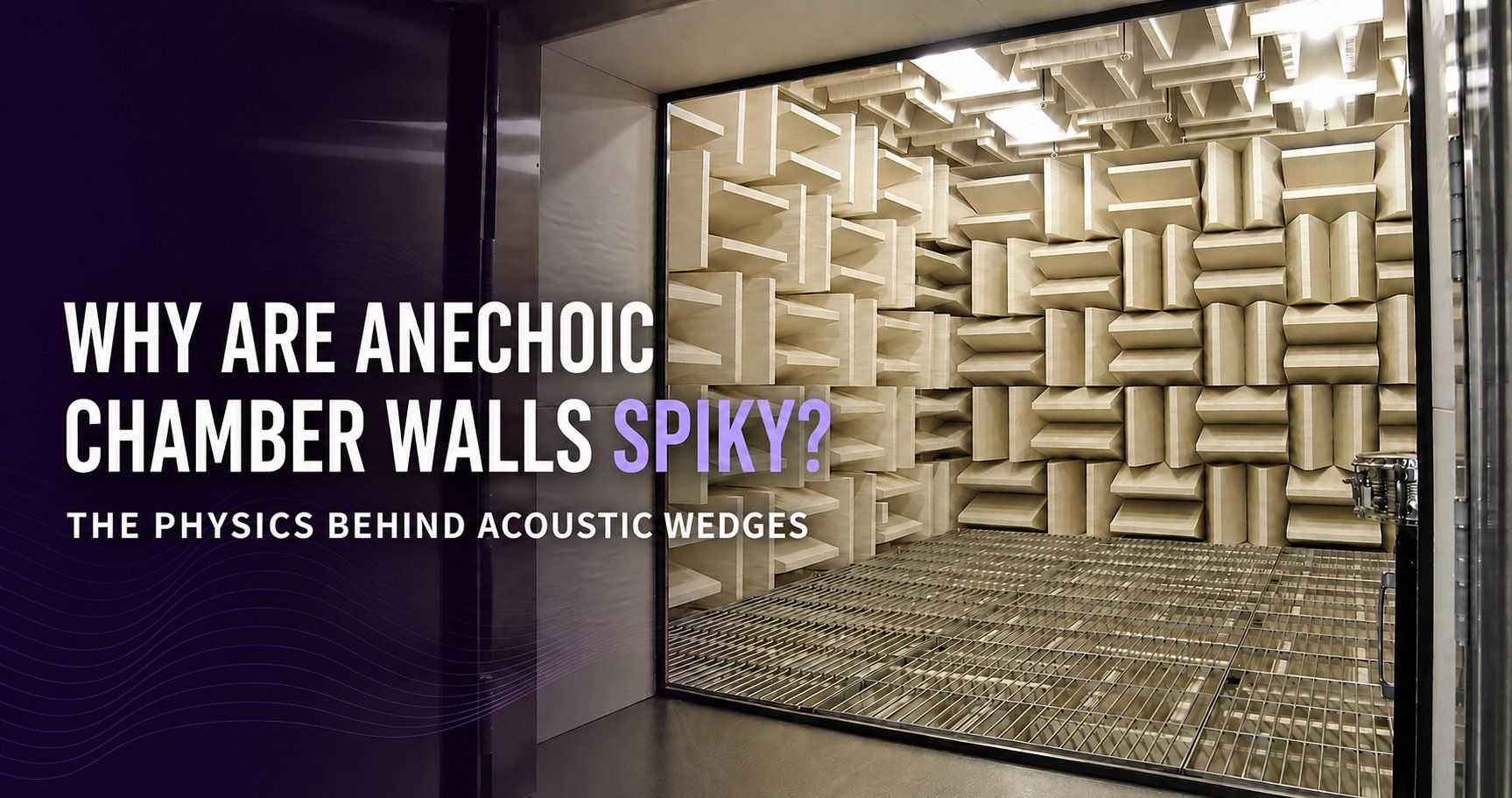
2026.08.03
Why Are Anechoic Chamber Walls Spiky? How Acoustic Wedges Work -
2026.07.28
White Noise vs Pink Noise vs Sweep Signals -
2026.07.13
Acoustic Adjustment with Soundproof Partitions ― Applications for Anechoic Chamber Tuning, Simplified Acoustic Measurements, and STI Environment Design ― -
2026.07.08
Why HBK × SONORA? ― The Benefits of Integrating Acoustic Instrumentation and Acoustic Test Environments ― -

2026.05.18
Misconceptions About a Sound Absorption Coefficient of 0.99 ― How ISO 3745:2012 Changed the Philosophy of Anechoic Room Evaluation ― -
2026.05.13
How to Use HATS ― Operating a Measurement System That Reproduces the Human Head and Ears Within the Framework of Standards and Acoustic Environments ― -
2026.04.13
Evaluation Methods in Building Acoustics: Streamlining Field Measurements and Material Assessment in Laboratory Environments -
2026.03.23
We participated in the corporate exhibition at the Acoustical Society of Japan (ASJ) Meeting on March 19, 2026 -
2026.03.10
How to Read Standards Related to Anechoic Chambers ― Organizing Sound Power Measurement Standards and Qualification of Test Environments ― -
2026.01.29
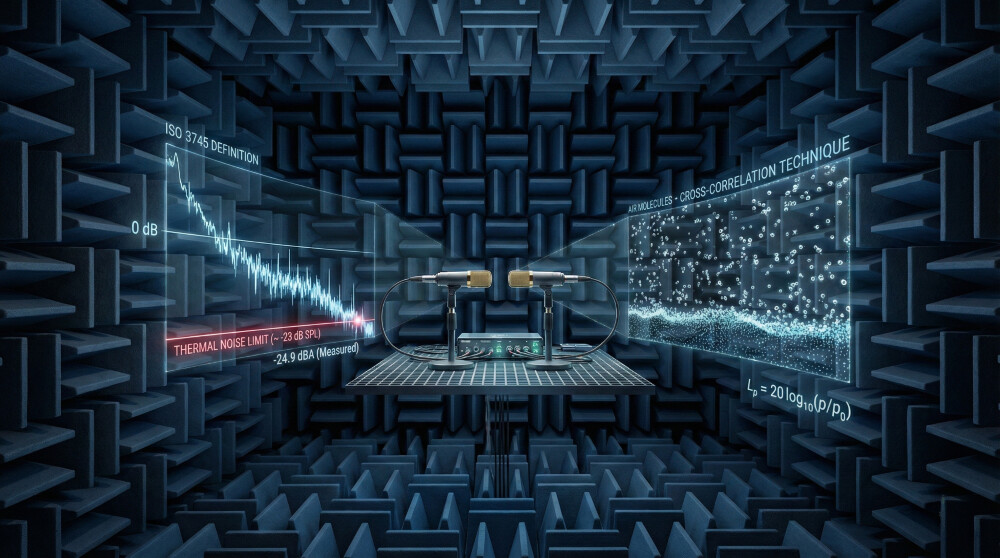
Can We Create “Absolute Silence” on Earth? — An Academic Reading of Anechoic Chambers and Ultra-Low Background-Noise Measurement —

Contact Us
- Contact us by email
-
- Contact us by phone
-
Moritani Shokai
(Machinery Department No. 2, Tokyo Head Office)


Introduction of the Manufacturer
-
Hottinger Bruel & Kjaer
HHBK is a merger of two companies: Brüel & Kjær of Denmark and HBM of Germany.
Brüel & Kjær is one of the world’s leading manufacturers of acoustic and vibration measurement instruments, known as a total measurement chain supplier.Learn more about HBK
-
Sonora Technology Co., Ltd.
Sonora Technology is a leading Japanese manufacturer of industrial anechoic chambers and anechoic boxes.
From design and manufacturing to installation and acoustic performance assurance, Sonora provides fully integrated solutions to build complete acoustic measurement environments from the ground up.Learn more about Sonora
Contact / Request Brochure
For inquiries or consultations regarding the total solutions provided by HBK × Sonora, please feel free to contact us using the Contact button.
If you would like a brochure sent by mail, please use the Request Brochure button.