

Technical Column
Integrated Design of Anechoic Chambers with Auxiliary Equipment — Balancing Silence and Functionality —
Dec 6, 2025
- HBK × SONORA Acoustic Measurement Solution Official Website
- Technical Column
- Integrated Design of Anechoic Chambers with Auxiliary Equipment — Balancing Silence and Functionality —
Introduction
Anechoic chambers are designed for acoustic precision, but in real industrial and research environments, they rarely exist in isolation.
They are integrated with auxiliary systems—wind tunnels, temperature control units, power supplies, conveyors, and measurement devices.
The challenge: maintaining acoustic performance while preserving functionality.
This article discusses the design philosophy of integrating acoustics and equipment into a single, coherent system.
From Isolated to Integrated Acoustic Design
Traditional chamber design focused on the room itself—its absorption and insulation.
However, as test accuracy increases, interactions between the chamber and its attached systems can degrade results.
Typical examples include:
- Fan noise from airflow systems
- Air handling and duct resonance
- Structural vibration from equipment bases
- Acoustic leakage through conduits or cable paths
Therefore, modern acoustic design treats the chamber and its systems as a unified noise-controlled structure, not as separate entities.
Key Components of an Integrated System
| Component | Function | Acoustic Design Focus |
|---|---|---|
| Air handling | Controls temperature/humidity | Quiet ducts, vibration isolation, low static loss |
| Access & handling | Sample transport, doors | Airtight seals, heavy acoustic doors |
| Equipment base | Test machines | Floating or decoupled foundation |
| Power & signal lines | Data and control | Shielding and isolated penetrations |
Penetration points are critical:
any weak point can become a direct noise leakage path.
Proper sealing and mechanical decoupling are essential.
Three Core Approaches to Integrated Design
Modular Isolation
Segment equipment into independent acoustic/vibration blocks.
Resonance Control
Detune system frequencies from chamber resonance modes.
Boundary Management
Isolate mechanical and acoustic boundaries to prevent cross-transmission.
Together, these ensure both functional operation and acoustic precision.
Structural Philosophy for Performance Assurance
Integrated systems must be validated as a whole, not just as individual parts.
Verification includes:
- K₂ deviation testing of the chamber itself
- Operational noise tests with auxiliary systems running
- Reproducibility checks under thermal and vibrational conditions
Only by testing in “working conditions” can we guarantee repeatable silence under operation.
Material and Structural Considerations
The materials and components used must support both performance and maintainability:
- Broadband sound absorption across low–high frequencies
- Environmental stability under temperature and vibration
- Non-fibrous, low-dust structures for clean integration with machinery
Such materials enable a holistic approach to acoustic and environmental control.
Conclusion: Designing Harmony Between Sound and System
The ideal anechoic chamber is not only quiet—it is functional without compromise.
By designing acoustics and equipment together, we move from “quiet rooms” to integrated precision environments.
In this harmony of structure and system, silence becomes not an absence of sound, but a designed condition of performance.
Latest Posts in Technical Column
-
2026.01.29
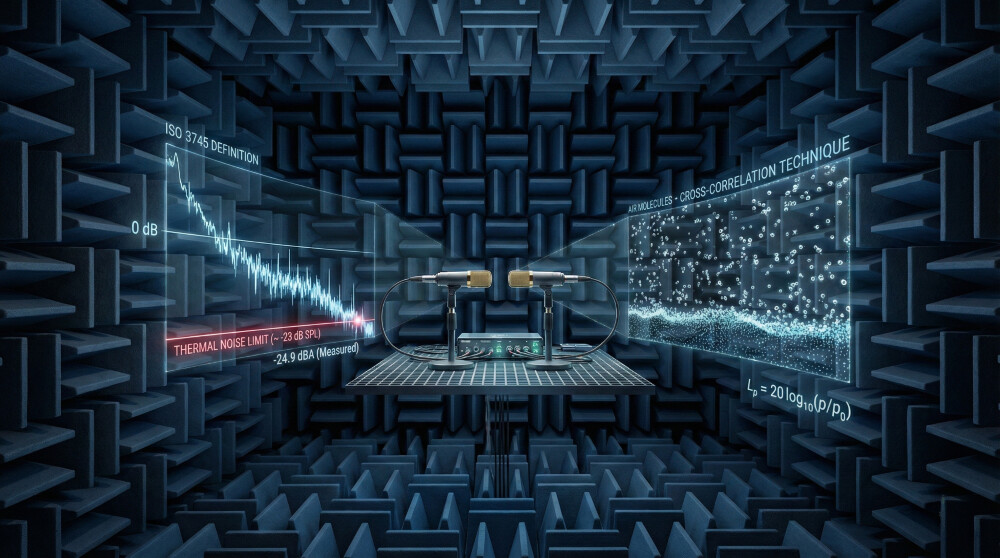
Can We Create “Absolute Silence” on Earth? — An Academic Reading of Anechoic Chambers and Ultra-Low Background-Noise Measurement — -

2025.12.11
The Geometry of Acoustic Design — How Chamber Shape Defines Sound Field Performance -
2025.12.06
Integrated Design of Anechoic Chambers with Auxiliary Equipment — Balancing Silence and Functionality — -
2025.11.30
Modular Semi-Anechoic Chambers — A Flexible Solution for Deployable Acoustic Testing — -
2025.11.25
Measuring Silence: How Anechoic Chambers Support Industrial Quality -
2025.11.18
Designing for Reproducibility — Environmental Stabilization in Acoustic Measurement — -
2025.11.13
The New Generation of Mobile Acoustic Measurement — Field Accuracy for Building and Environmental Sound Testing — -
2025.11.07
The Design Logic Behind the Inverse Square Law Zone in Anechoic Chambers -
2025.10.31
Acoustic Cameras and Anechoic Chambers — Visualizing Silence for Sound Source Analysis — -
2025.10.25
Integrated Acoustic and Vibration Analysis — Designing the Data Flow That Connects Measurement and Insight—

Contact Us
- Contact us by email
-
- Contact us by phone
-
Moritani Shokai
(Machinery Department No. 2, Tokyo Head Office)


Introduction of the Manufacturer
-

Hottinger Bruel & Kjaer
HHBK is a merger of two companies: Brüel & Kjær of Denmark and HBM of Germany.
Brüel & Kjær is one of the world’s leading manufacturers of acoustic and vibration measurement instruments, known as a total measurement chain supplier.Learn more about HBK
-
Sonora Technology Co., Ltd.
Sonora Technology is a leading Japanese manufacturer of industrial anechoic chambers and anechoic boxes.
From design and manufacturing to installation and acoustic performance assurance, Sonora provides fully integrated solutions to build complete acoustic measurement environments from the ground up.Learn more about Sonora
Contact / Request Brochure
For inquiries or consultations regarding the total solutions provided by HBK × Sonora, please feel free to contact us using the Contact button.
If you would like a brochure sent by mail, please use the Request Brochure button.