

Technical Column
Can We Create “Absolute Silence” on Earth? — An Academic Reading of Anechoic Chambers and Ultra-Low Background-Noise Measurement —
Jan 29, 2026
- HBK × SONORA Acoustic Measurement Solution Official Website
- Technical Column
- Can We Create “Absolute Silence” on Earth? — An Academic Reading of Anechoic Chambers and Ultra-Low Background-Noise Measurement —
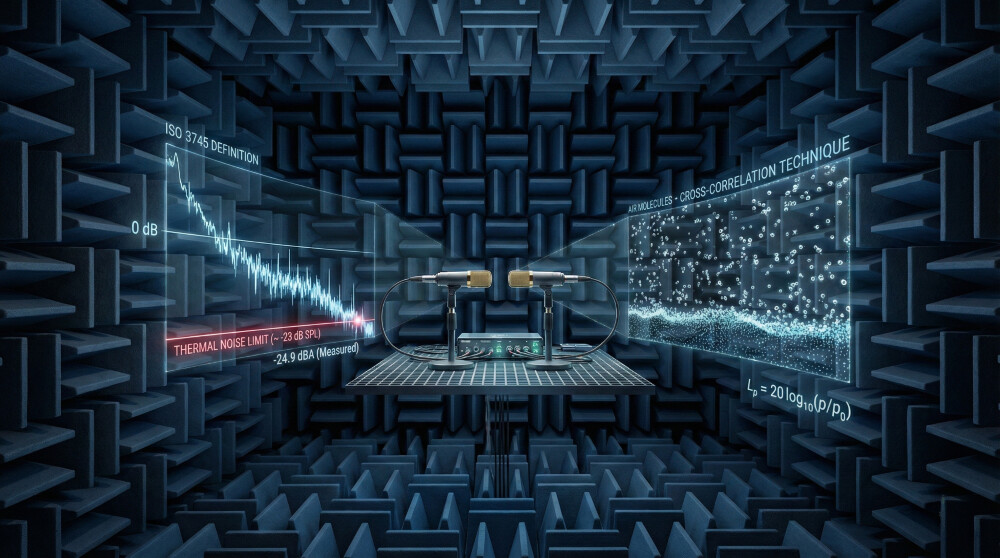
In Sonora Technology’s official article “Can a Truly Silent Space Be Created on Earth?”, we provided an overview of the physical and engineering limits of anechoic chambers.
But if we take this same theme and thoroughly deconstruct and reconstruct it from the perspectives of acoustical engineering, thermodynamics, statistical physics, measurement theory, and international standards (ISO 3745), what kind of framework emerges?
As an experiment, we posed that question to an AI. Starting from the numerical values behind the Guinness World Records designation of the “quietest place on Earth,” the AI’s response calmly organized—across multiple domains—topics such as:
- the physical definition of the decibel,
- the meaning of the A-weighting metric (dB(A)) as an evaluation scale,
- the thermal-noise limit caused by Brownian motion of air molecules,
- ultra-low-level measurement via the cross-correlation technique, and
- the essential definition of an “anechoic room” under ISO 3745,
and, in doing so, clarified “what those numbers mean—and what they do not mean.” It was a remarkably thought-provoking answer.
On this page, we share that AI’s academic discussion largely as-is.
Please note that this content is not intended to refute or evaluate any specific record or corporate claim, nor does it represent an official position or measurement guarantee by HBK or Sonora. Rather, it is offered as a tool for organizing one’s thinking—especially for specialists, engineers, and researchers—on the question:
“How should we correctly interpret the numerical ‘quietness’ of anechoic chambers from an engineering standpoint?”
(Main Text: Original Content, Unmodified)
Technical Verification of Anechoic Chamber Quietness and the Scientific Reliability of Guinness World Records
A Comprehensive Analysis of Physical Limits and Measurement Methodologies in Extreme Acoustic Environments
1. Introduction: Definition of Silence and the Modern Pursuit of “The Quietest Place on Earth”
In the field of acoustical engineering, “silence” does not signify the absolute absence of sound, but rather a condition in which the physical energy level of acoustic fluctuations is reduced to an extreme minimum. In contemporary industrial and academic contexts, increasingly precise product evaluation and fundamental scientific research demand the realization of a true free field and an ultra-low background noise environment. At the pinnacle of such environments stands the anechoic chamber.
In recent years, Orfield Laboratories in Minnesota and Microsoft’s Audio Lab in Washington State have competed for the Guinness World Records title of “The Quietest Place on Earth.” In particular, the background noise level of −24.9 dB(A) reported by Orfield Laboratories has astonished the general public. At the same time, from a professional acoustics perspective, this value has provoked debate regarding its consistency with the physical limits imposed by the thermal (Brownian) motion of air molecules.
This article comprehensively examines the technical validity of these ultra-low-level acoustic measurements from the perspectives of thermodynamics, statistical mechanics, and signal processing. Furthermore, based on international standards governing anechoic chambers (such as ISO 3745) and technical viewpoints provided by professional institutions including HBK (Hottinger Brüel & Kjær), it clarifies the discrepancy between the practical limits of industrial measurement environments and the academic interpretation of numerical values certified as Guinness World Records.
2. Fundamental Theory of Acoustic Measurement and the Physical Meaning of Decibels
To correctly understand the concept of “negative decibels,” it is necessary to rigorously define the reference values and logarithmic nature of acoustic measurement scales. A common misconception is that 0 dB represents silence; in reality, it does not.
2.1 Definition of Sound Pressure Level (SPL)
Sound Pressure Level (Lp) is defined using the logarithmic ratio between the measured root-mean-square sound pressure (p) and the reference sound pressure (p0):
Lp = 20 × log10(p / p0)
In air, the reference sound pressure is internationally defined as:
p0 = 20 microPascal = 2 × 10^-5 Pascal
This value approximates the threshold of hearing for a healthy young person at 1 kHz and is therefore defined as 0 dB SPL [14].
2.2 Mathematical and Physical Validity of Negative Decibels
When the measured sound pressure p is smaller than the reference pressure p0, the logarithmic argument becomes less than unity, resulting in a negative decibel value. Consequently, negative decibel values are mathematically and physically valid representations of existing sound pressure levels [14].
For example, −20 dB SPL corresponds to:
p = 2 microPascal
The value of −24.9 dB(A) reported by Orfield Laboratories corresponds to an extremely small pressure fluctuation of approximately:
p ≈ 1.1 microPascal
This does not imply a vacuum, but rather an extremely low acoustic energy level relative to the reference. The critical question is whether such minute pressure fluctuations can fall below the pressure variations caused by the thermal motion of air molecules.
2.3 Importance of Frequency Weighting Characteristics
One of the most important factors in evaluating these measurements is the frequency weighting applied to the data, particularly A-weighting. It is essential to note that the reported unit is not “dB” but “dB(A).”
- Z-weighting (zero-frequency weighting): no frequency weighting is applied; the physical sound pressure level is evaluated uniformly over a broad frequency range [14].
- A-weighting: a filtering process that approximates human hearing sensitivity (approximately 40 phon), strongly attenuating low-frequency components (for example, −39.4 dB at 31.5 Hz) and emphasizing the 1–5 kHz region [14].
Environmental noise sources such as thermal noise and ground vibration generally contain substantial low-frequency energy. By applying A-weighting, much of this physically present low-frequency energy is removed from the calculation, resulting in numerically lower values than those obtained with Z-weighting. This filtering mechanism is a key factor in explaining the discrepancy between reported record values and thermodynamic limits [14].
3. Thermodynamic Limits: Brownian Motion of Air and the Noise Floor
Regardless of how effectively an anechoic chamber is acoustically isolated, absolute silence cannot be achieved as long as air is present inside the chamber. Gas molecules possess thermal energy above absolute zero and undergo random motion known as Brownian motion. Collisions of these molecules with the eardrum or a microphone diaphragm produce unavoidable pressure fluctuations, known as thermal noise.
3.1 Acoustic Limits Based on Molecular Kinetic Theory
Several historically significant studies have addressed the lower limit of acoustic noise in air.
Sivian and White (1933) suggested that the human hearing threshold may be constrained by thermal agitation of air molecules [8].
Harris (1968) calculated Brownian motion noise in a free field and derived a level corresponding to approximately −24 dB SPL within a 1 kHz bandwidth centered at 3 kHz [8].
Modern acoustical physics generally agrees that, at room temperature (approximately 20 degrees Celsius), the thermal noise level integrated over the entire audible frequency range (20 Hz to 20 kHz) is approximately −23 dB SPL [6].
3.2 Physical Interpretation of −24.9 dB(A)
The −24.9 dB(A) value reported by Orfield Laboratories lies below the commonly cited theoretical limit of −23 dB SPL. To explain this without violating physical laws, several factors must be considered:
- Interaction between bandwidth limitation and A-weighting
Brownian motion noise is often described as increasing with frequency (so-called violet noise, +6 dB per octave). A-weighting attenuates both low-frequency and high-frequency components, potentially reducing the integrated A-weighted energy. - Temperature dependence
The power of thermal noise is proportional to absolute temperature (P proportional to kT). Reducing the noise level by approximately 2 dB would require reducing absolute temperature by nearly half, which is unrealistic for a human-accessible facility. - Statistical variation and measurement uncertainty
Noise is a stochastic process. While short-term averages may fall below the theoretical mean, Guinness World Records measurements rely on long-term integration, making statistical fluctuation alone an insufficient explanation.
The most reasonable interpretation is that A-weighting removes a portion of the dominant thermal noise energy from the calculation, yielding an A-weighted value that appears lower than the broadband physical limit. This represents an artifact of the evaluation metric rather than a violation of physical law.
4. Measurement Techniques in Extreme Environments: Extracting Signals Buried in Noise
Measuring sound levels on the order of −20 dB is impossible using conventional sound level meters. Even state-of-the-art low-noise microphones (for example, Brüel & Kjær Type 4955) typically exhibit self-noise levels of approximately 5.5 dB(A) [18]. This places the target signal roughly 25 dB below the instrument noise floor.
4.1 Techniques Beyond the Self-Noise Limit
Because single-microphone measurements are insufficient, specialized signal processing techniques are required. Guinness World Records measurements employ the dual-microphone coherent power method, also known as the cross-correlation technique [9].
4.2 Principle of the Cross-Correlation Method
Two identical low-noise microphones are placed in close proximity and operated simultaneously.
- Correlated components
Acoustic energy present in the chamber arrives at both microphones with similar phase and amplitude. - Uncorrelated components
Microphone self-noise originates independently within each microphone and is therefore uncorrelated [18].
By computing the cross-correlation of the two signals and averaging over a long integration time, uncorrelated self-noise converges toward zero, while correlated environmental noise remains detectable. This enables extraction of signals far below the self-noise floor of individual microphones.
Using this approach, the −20.6 dB(A) record achieved by Microsoft and the −24.9 dB(A) record reported by Orfield Laboratories were mathematically extracted from beneath the microphone noise floor [1].
4.3 Measurement Uncertainty and Integration Time
The accuracy of this method depends strongly on integration time. When the target signal lies far below the noise floor, extremely long averaging times are required to achieve an adequate signal-to-noise ratio [9]. Publicly available information provides limited detail regarding the specific integration times used in Orfield Laboratories’ measurements.
5. Anechoic Chamber Design and ISO Standards
Beyond record-setting quietness, the performance of industrial anechoic chambers is strictly defined by international standards, primarily ISO 3745 and ISO 3744.
5.1 Transition from ISO 3745:2003 to ISO 3745:2012
ISO 3745:2003 specified explicit structural requirements, including absorber performance and geometry.
A typical requirement for absorber depth was:
d ≥ lambda / 4 = c / (4 × f)
In ISO 3745:2012, these prescriptive structural requirements were removed. The standard shifted to a performance-based approach in which an anechoic room is defined by conformity with the inverse square law, regardless of absorber shape or construction.
5.2 Inverse Square Law Performance Evaluation
A defining characteristic of an anechoic room is the realization of a free field, where sound pressure decreases by 6 dB for each doubling of distance from a point source. ISO 3745 and JIS Z 8732 specify allowable deviations from this law depending on frequency range.
5.3 Background Noise and Environmental Correction
When background noise is not sufficiently lower than the sound emitted by the source under test, a background noise correction is applied:
K1 = −10 × log10(1 − 10^(−0.1 × (Lp − Lb)))
According to HBK technical guidance [5], achieving environmental correction values below 2 dB is extremely difficult in practice. For many industrial applications, targeting K2 ≤ 4 dB under ISO 3744 conditions is considered realistic. This highlights the exceptional technical challenge involved in constructing a full anechoic chamber compliant with ISO 3745.
6. Case Study: Orfield Laboratories vs. Microsoft
6.1 Orfield Laboratories
Orfield Laboratories in Minneapolis previously held records of −9.4 dB(A) in 2004 and −13 dB(A) in 2012 [20]. In November 2021, the laboratory reclaimed the title with a reported level of −24.9 dB(A) [1].
The chamber features approximately one-meter-thick fiberglass wedges, double insulated steel walls, and a concrete outer structure. To minimize external vibration, the entire chamber is mounted on spring isolators [1]. While the use of NIST-traceable procedures and Brüel & Kjær instrumentation has been indicated, detailed peer-reviewed explanations for exceeding the −23 dB thermal noise limit have not been publicly disclosed.
6.2 Microsoft Audio Lab (Building 87)
Microsoft’s anechoic chamber in Building 87 achieved −20.35 dB(A) in 2015, setting a world record at the time [6]. Measurements were conducted using two low-noise microphones and the cross-correlation method by independent engineers. Microsoft’s engineering team explicitly stated that this value approached, but did not exceed, the Brownian motion limit [6].
6.3 Comparative Discussion
Microsoft’s result lies within the physically plausible range relative to the thermal noise limit, whereas Orfield’s −24.9 dB(A) appears to exceed it. This apparent contradiction is best explained by weighting effects, bandwidth limitation, and statistical signal processing rather than by an actual violation of physical limits.
7. Guinness World Records Verification and Scientific Reliability
Guinness World Records certification confirms that a measurement yielded a specific value under approved conditions. It does not guarantee that the physical interpretation of that value is correct.
From a scientific perspective, values such as −24.9 dB(A) should be regarded as engineering measurement achievements rather than evidence of new physical limits.
8. Human Perception and Psychological Effects: The “45-Minute Myth”
The claim that humans cannot remain in anechoic chambers for more than 45 minutes is largely exaggerated [20].
When external sound is eliminated, internal physiological sounds such as heartbeat and blood flow become perceptible. In addition, the absence of reflected sound disrupts spatial orientation cues, potentially causing discomfort or disorientation. In practice, engineers routinely work in anechoic chambers for extended periods.
9. Conclusion
The quietest anechoic chambers on Earth represent extraordinary engineering achievements. However, negative decibel values should be interpreted as logarithmic, A-weighted engineering metrics rather than indicators of absolute silence.
Proper understanding requires careful consideration of frequency weighting, bandwidth, and statistical signal processing.
References
(Accessed January 28, 2026)
A. Official and Primary Sources
[1] Guinness World Records, “Quietest place.” https://www.guinnessworldrecords.com/world-records/quietest-place
[2] Guinness World Records, “Guide to your evidence.” https://www.guinnessworldrecords.com/records/how-to-collect-and-submit-evidence/guide-to-your-evidence-2022.pdf
[3] Guinness World Records, “Microsoft lab sets new record for the world’s quietest place.” https://www.guinnessworldrecords.com/news/2015/10/microsoft-lab-sets-new-record-for-the-worlds-quietest-place-399444
[4] Guinness World Records, “Inside quietest place on Earth.” https://www.guinnessworldrecords.com/news/2024/8/inside-quietest-place-on-earth-where-you-can-hear-your-blood-pumping-and-eyes-blinking
[5] HBK, “The Quietest Place In The World.” https://www.hbkworld.com/en/knowledge/resource-center/articles/worlds-quietest-room
[6] Microsoft News, “Audio Lab: Inside B87.” https://news.microsoft.com/stories/building87/audio-lab.php
[7] Orfield Laboratories, “The Quietest Place on Earth.” https://www.orfieldlabs.com/about/the-quietest-place-on-earth
B. Academic and Technical Sources
[8] AIP Publishing (JASA), “Comments on ‘What is silence? Therefore, what is sound?’” https://pubs.aip.org/asa/jasa/article/155/6/3604/3295655/Comments-on-What-is-silence-Therefore-what-is
[9] IEEE Xplore, “Performance analysis of correlation techniques for noise measurements.” https://ieeexplore.ieee.org/document/7288585/
[10] Physics Stack Exchange, “How did they measure −20 dB sound?” https://physics.stackexchange.com/questions/391569/how-did-they-measure-20-db-sound
[11] Physics Stack Exchange, “How loud is the thermal motion of air molecules?” https://physics.stackexchange.com/questions/110540/how-loud-is-the-thermal-motion-of-air-molecules
[12] SiTime, “AN10062 Phase Noise Measurement Guide for Oscillators.” https://www.sitime.com/support/resource-library/application-notes/an10062-phase-noise-measurement-guide-oscillators
[13] White Rose Research Online, “A Low-Cost Cross-Correlation Residual Phase Noise Measurement System.” https://eprints.whiterose.ac.uk/id/document/3356265
C. Decibel and Fundamental Concepts
[14] Svantek Academy, “Sound Pressure Level (SPL).” https://svantek.com/academy/sound-pressure-level-spl/
[15] UNSW Physclips, “dB: What is a decibel?” https://www.animations.physics.unsw.edu.au/jw/dB.htm
[16] Wikipedia, “Sound pressure.” https://en.wikipedia.org/wiki/Sound_pressure
[17] FAA, “Fundamentals of Noise and Sound.” https://www.faa.gov/regulations_policies/policy_guidance/noise/basics
D. Microphone Self-Noise
[18] DPA Microphones, “The basics about noise in mics.” https://www.dpamicrophones.com/mic-university/technology/the-basics-about-noise-in-mics/
[19] AudioTechnology, “Microphones: Noise 1.” https://www.audiotechnology.com/tutorials/microphones-noise-1
E. Supplementary Sources
[20] Smithsonian Magazine, “In the Earth’s Quietest Room, You Can Hear Yourself Blink.” https://www.smithsonianmag.com/smart-news/earths-quietest-room-you-can-hear-yourself-blink-180948160/
[21] Wikipedia, “Orfield Laboratories.” https://en.wikipedia.org/wiki/Orfield_Laboratories
[22] Wikipedia, “Anechoic chamber.” https://en.wikipedia.org/wiki/Anechoic_chamber
[23] ENMO, “Microsoft breaks record for quietest place on earth.” https://www.enmo.eu/microsoft-breaks-record-for-quietest-place-on-earth/
[24] In Compliance Magazine, “Microsoft’s Anechoic Chamber is the Quietest Place on Earth.” https://incompliancemag.com/microsofts-anechoic-chamber-is-the-quietest-place-on-earth/
[25] Reddit (supplementary), “ELI5… Orfield Laboratories… negative decibel levels….” https://www.reddit.com/r/explainlikeimfive/comments/76jgud/eli5_an_anechoic_chamber_at_orfield_laboratories/
Latest Posts in Technical Column
-
2026.03.10
How to Read Standards Related to Anechoic Chambers ― Organizing Sound Power Measurement Standards and Qualification of Test Environments ― -
2026.01.29
Can We Create “Absolute Silence” on Earth? — An Academic Reading of Anechoic Chambers and Ultra-Low Background-Noise Measurement — -

2025.12.11
The Geometry of Acoustic Design — How Chamber Shape Defines Sound Field Performance -
2025.12.06
Integrated Design of Anechoic Chambers with Auxiliary Equipment — Balancing Silence and Functionality — -
2025.11.30
Modular Semi-Anechoic Chambers — A Flexible Solution for Deployable Acoustic Testing — -
2025.11.25
Measuring Silence: How Anechoic Chambers Support Industrial Quality -
2025.11.18
Designing for Reproducibility — Environmental Stabilization in Acoustic Measurement — -
2025.11.13
The New Generation of Mobile Acoustic Measurement — Field Accuracy for Building and Environmental Sound Testing — -
2025.11.07
The Design Logic Behind the Inverse Square Law Zone in Anechoic Chambers -
2025.10.31
Acoustic Cameras and Anechoic Chambers — Visualizing Silence for Sound Source Analysis —

Contact Us
- Contact us by email
-
- Contact us by phone
-
Moritani Shokai
(Machinery Department No. 2, Tokyo Head Office)


Introduction of the Manufacturer
-

Hottinger Bruel & Kjaer
HHBK is a merger of two companies: Brüel & Kjær of Denmark and HBM of Germany.
Brüel & Kjær is one of the world’s leading manufacturers of acoustic and vibration measurement instruments, known as a total measurement chain supplier.Learn more about HBK
-
Sonora Technology Co., Ltd.
Sonora Technology is a leading Japanese manufacturer of industrial anechoic chambers and anechoic boxes.
From design and manufacturing to installation and acoustic performance assurance, Sonora provides fully integrated solutions to build complete acoustic measurement environments from the ground up.Learn more about Sonora
Contact / Request Brochure
For inquiries or consultations regarding the total solutions provided by HBK × Sonora, please feel free to contact us using the Contact button.
If you would like a brochure sent by mail, please use the Request Brochure button.