

Technical Column
The Geometry of Acoustic Design — How Chamber Shape Defines Sound Field Performance
Dec 11, 2025
- HBK × SONORA Acoustic Measurement Solution Official Website
- Technical Column
- The Geometry of Acoustic Design — How Chamber Shape Defines Sound Field Performance
Acoustic Power Measurement
Introduction
The performance of an anechoic chamber is not determined only by absorption materials.
It depends on how sound travels, reflects, and disappears within the space.
This article explores how geometry and structure determine acoustic performance, focusing on reflection control and spatial uniformity.
The Principle: Designing to Prevent Reflection
An anechoic chamber does not simply absorb sound—it is designed to prevent reflections from forming in the first place.
Key design principles include:
- Avoid parallel walls to suppress standing waves.
- Use asymmetric arrangements to scatter reflections.
- Treat surfaces as volumes, not planes, to eliminate resonant cavities.
These principles ensure that sound energy is evenly dispersed and quickly absorbed.
Geometric Effects on Acoustic Behavior
Rectangular vs. Polygonal
- Rectangular rooms are easy to construct but prone to directional reflections.
- Polygonal or irregular shapes scatter sound paths, improving field uniformity.
Ceiling and Floor Angles
- Slightly tilted floors prevent reflection loops.
- Asymmetric ceiling wedges enhance diffusion in higher frequencies.
Geometry transforms the room into a non-reflective acoustic landscape.
Balancing Reflection and Diffusion
Total elimination of reflection is impossible.
The goal is to make reflections inconspicuous through diffusion.
Methods include:
- Randomized wedge or panel arrangement
- Non-parallel wall spacing
- Small discontinuities at panel joints
These techniques spread residual reflections evenly, ensuring a stable, uniform sound field.
Floor and Equipment Integration
Equipment placement affects the acoustic field.
Floor reflections and structure-borne vibrations must be minimized.
Solutions include:
- Perforated or grated acoustic flooring
- Isolated vibration-damping mounts for test rigs
- Cable routing through walls to remove enclosed underfloor cavities
These mechanical and acoustic strategies maintain the purity of silence.
Acoustic Uniformity and Simulation
Modern design relies on 3D acoustic simulation (FEM/BEM) to predict reflection paths and sound pressure distribution.
This allows the chamber geometry to be optimized for measurement uniformity and reproducibility.
A well-designed chamber yields results independent of microphone position.
Conclusion: Silence Shaped by Geometry
Silence is not an absence—it is a designed condition.
Every edge, angle, and junction determines how sound behaves.
To design a quiet space is to design the path of sound itself.
That is the geometry behind the measurable silence of anechoic chambers.
Latest Posts in Technical Column
-
2026.03.10
How to Read Standards Related to Anechoic Chambers ― Organizing Sound Power Measurement Standards and Qualification of Test Environments ― -
2026.01.29
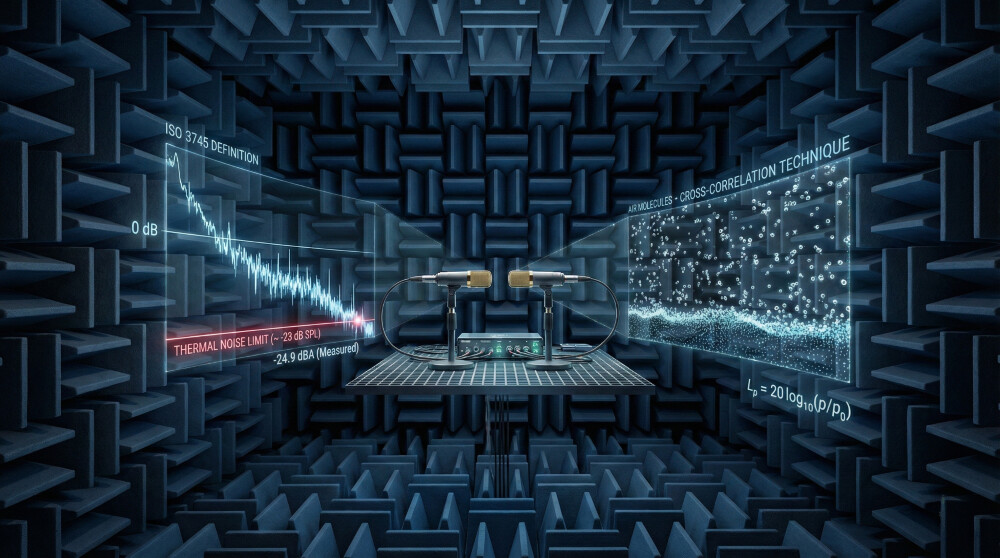
Can We Create “Absolute Silence” on Earth? — An Academic Reading of Anechoic Chambers and Ultra-Low Background-Noise Measurement — -

2025.12.11
The Geometry of Acoustic Design — How Chamber Shape Defines Sound Field Performance -
2025.12.06
Integrated Design of Anechoic Chambers with Auxiliary Equipment — Balancing Silence and Functionality — -
2025.11.30
Modular Semi-Anechoic Chambers — A Flexible Solution for Deployable Acoustic Testing — -
2025.11.25
Measuring Silence: How Anechoic Chambers Support Industrial Quality -
2025.11.18
Designing for Reproducibility — Environmental Stabilization in Acoustic Measurement — -
2025.11.13
The New Generation of Mobile Acoustic Measurement — Field Accuracy for Building and Environmental Sound Testing — -
2025.11.07
The Design Logic Behind the Inverse Square Law Zone in Anechoic Chambers -
2025.10.31
Acoustic Cameras and Anechoic Chambers — Visualizing Silence for Sound Source Analysis —

Contact Us
- Contact us by email
-
- Contact us by phone
-
Moritani Shokai
(Machinery Department No. 2, Tokyo Head Office)


Introduction of the Manufacturer
-

Hottinger Bruel & Kjaer
HHBK is a merger of two companies: Brüel & Kjær of Denmark and HBM of Germany.
Brüel & Kjær is one of the world’s leading manufacturers of acoustic and vibration measurement instruments, known as a total measurement chain supplier.Learn more about HBK
-
Sonora Technology Co., Ltd.
Sonora Technology is a leading Japanese manufacturer of industrial anechoic chambers and anechoic boxes.
From design and manufacturing to installation and acoustic performance assurance, Sonora provides fully integrated solutions to build complete acoustic measurement environments from the ground up.Learn more about Sonora
Contact / Request Brochure
For inquiries or consultations regarding the total solutions provided by HBK × Sonora, please feel free to contact us using the Contact button.
If you would like a brochure sent by mail, please use the Request Brochure button.