

Technical Column
How to Use HATS ― Operating a Measurement System That Reproduces the Human Head and Ears Within the Framework of Standards and Acoustic Environments ―
May 13, 2026
- HBK × SONORA Acoustic Measurement Solution Official Website
- Technical Column
- How to Use HATS ― Operating a Measurement System That Reproduces the Human Head and Ears Within the Framework of Standards and Acoustic Environments ―
Electroacoustic Measurement
Introduction
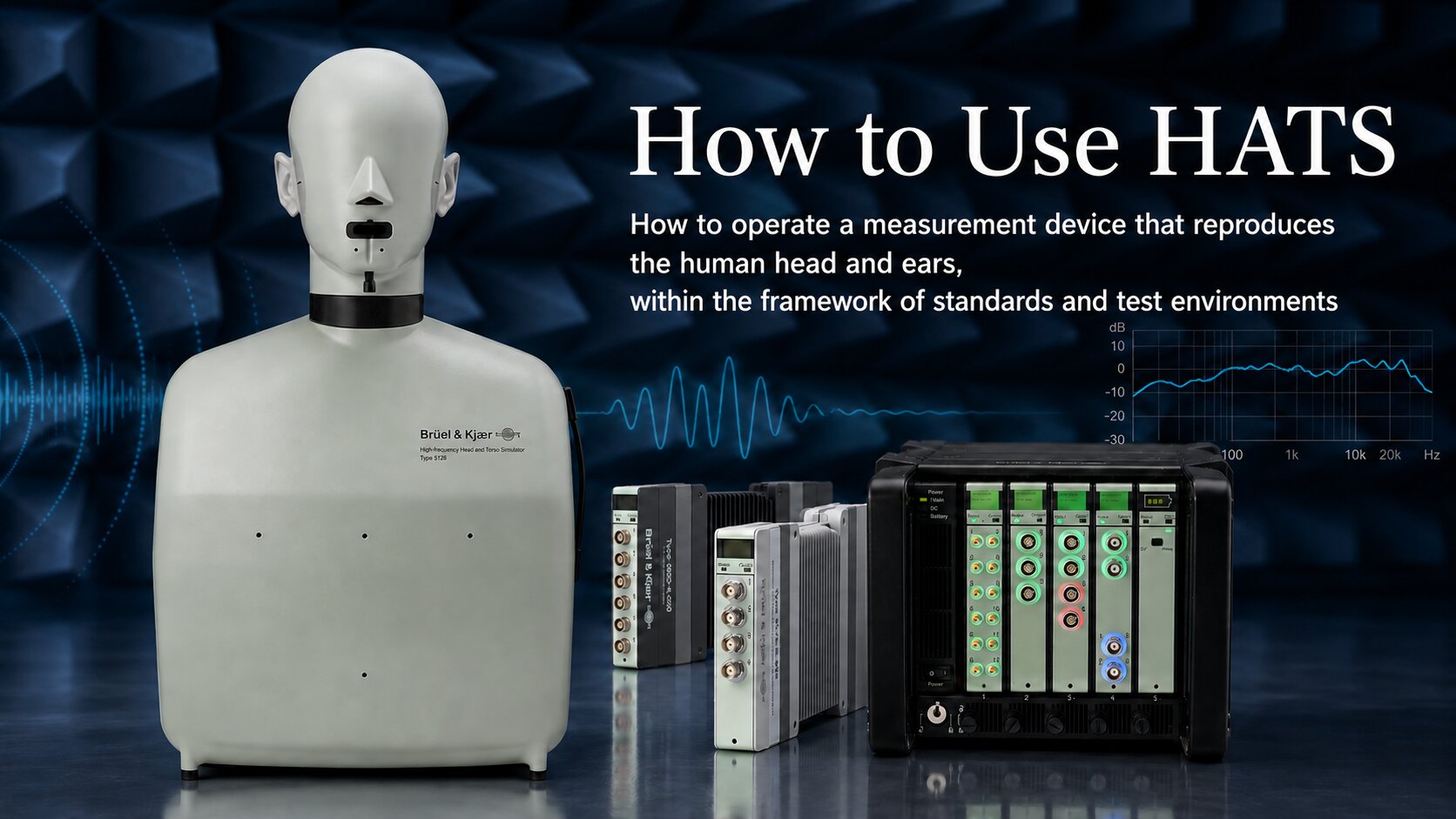
Smartphones, headphones, headsets, hearing aids, smart speakers, in-vehicle speakerphones—these are all products designed to deliver sound to the human ear.
To evaluate them properly, a measuring instrument is required that can reproduce the acoustic behavior mediated by the human body: sound pressure at the ear, diffraction and reflection caused by the head, and speech radiated from the mouth position.
That role is fulfilled by HATS, or Head and Torso Simulator.
This article explains the basic use of HATS from the perspectives of relevant standards, typical measurement scenarios, installation environments, and operational considerations. Product examples are discussed with reference to HBK HATS systems and the surrounding HBK measurement chain.
What Is HATS?
HATS is a manikin-type measurement instrument that reproduces the shape and acoustic characteristics of an average adult human head and torso.
Depending on the configuration, it may include:
- Artificial ears / ear simulators
These include microphones positioned at the eardrum location and couplers that simulate the acoustic impedance of the human ear canal and eardrum. - Mouth simulator
This is a loudspeaker that uses the lip position as the sound source and reproduces prescribed speech radiation characteristics from the mouth.
In speech quality testing, both send tests using the artificial mouth and receive tests using the artificial ears are important.
On the other hand, some models, such as tabletop HATS systems, are configured as head-only units. Therefore, whether a mouth simulator is included must be confirmed from the product configuration and specifications.
A major feature of HATS is that, depending on the configuration, it can be used both as the receiving side and the sound-emitting side.
| Receiving sound | HATS receives sound produced by headphones or speakers under conditions close to human listening and records it as sound pressure at the ear. |
|---|---|
| Emitting sound | In speech quality testing, HATS radiates signals equivalent to human speech from the mouth position and evaluates how the microphone on the device under test captures that sound. |
Main Standards Related to HATS
HATS is not simply a device that is “good to have.” The starting point for operation is to confirm which standard and which clauses the specific unit complies with.
Representative standards include the following.
ITU-T P.58, Latest Version 2023
ITU-T P.58 is a recommendation that specifies the acoustic characteristics of HATS for telephone measurements.
It defines acoustic characteristics of the mouth and artificial ears, free-field response, allowable distortion, levels, and other parameters. The framework covers artificial ears supporting narrowband, wideband, super-wideband, and fullband applications, while the artificial mouth supports narrowband, wideband, and super-wideband use.
It is effectively a foundational standard for speech quality testing.
IEC 60318-7:2022
IEC 60318-7:2022 is titled:
Electroacoustics — Simulators of human head and ear — Part 7: Head and torso simulator for the measurement of sound sources close to the ear
This standard specifies both the geometrical dimensions and acoustic characteristics of a manikin. Only systems satisfying both are considered compliant with the standard.
Its applicable frequency range is 100 Hz to 16 kHz. It covers airborne sound only and is not suitable for simulating bone conduction or the acoustic behavior of bones and tissue.
It replaced the former IEC TS 60318-7:2017.
IEC 60318-4:2010
IEC 60318-4:2010 specifies occluded-ear simulators for insert earphones coupled to the ear, such as through ear tips.
The applicable frequency range is 100 Hz to 10 kHz.
ITU-T P.57
ITU-T P.57 is a recommendation that defines types of ear simulators.
The Type 4620 ear simulator used in the HBK Type 5128 series is positioned as a Type 4.3 high-frequency ear simulator under ITU-T P.57. It is characterized by its ability to reproduce human-ear impedance up to 20 kHz.
ANSI/ASA S3.36
ANSI/ASA S3.36 is a U.S.-based manikin standard.
HBK Type 5128 series specifications may refer to compliance with ANSI S3.36-1985. However, ANSI/ASA S3.36-2012 also exists and covers broader applications, including hearing aids, hearing protectors, headphones, earphones, telephones, headsets, and hands-free telephones.
The actual applicable edition should be confirmed using the product specification sheet and calibration certificate.
Separating the Standard Scope from Product Measurement Capability
It is important to distinguish between the scope of a standard and the measurement range described in a product specification.
For example, IEC 60318-7:2022 defines a range of 100 Hz to 16 kHz. Meanwhile, the HBK Type 5128 / Type 4620 product specifications and its positioning as an ITU-T P.57 Type 4.3 high-frequency ear simulator emphasize measurement capability up to 20 kHz.
These should be understood as separate matters.
For insert earphones and air-conduction hearing aids, occluded-ear simulators based on IEC 60318-4:2010 may be used depending on the measurement objective.
By contrast, the Type 4620 installed in the HBK Type 5128 series is positioned under ITU-T P.57 Type 4.3. Therefore, while there may be overlapping applications, it is safer not to treat IEC 60318-4 and Type 5128 / Type 4620 as belonging to a single identical standards framework.
Main Uses of HATS When Configured with HBK Products
1. Measuring the Frequency Response of Headphones and Earphones
This is probably the easiest application to imagine.
A typical setup would involve:
- Mounting the headphones under test on both ears of an HBK Type 5128 series HATS, or inserting earphones into the ear canals
- Using HBK LAN-XI data acquisition hardware and BK Connect analysis software for signal generation and acquisition
- Playing sine sweeps, pink noise, log-swept sine signals, or similar test signals
- Acquiring sound pressure using the microphones inside the ear simulators and calculating the frequency response
The key point here is that the Type 4620 ear simulator installed in the Type 5128 reproduces the acoustic impedance, or load condition, of the human ear.
This makes it possible to obtain the response of headphones as they are actually worn on human ears, which cannot be achieved by measurement with a simple anechoic coupler.
One of the major advances of the Type 5128 over the older Type 4128 is that it secures these characteristics up to the upper end of the audible range, 20 kHz.
2. Speech Quality Testing of Smartphones, Handsets, and Headsets
In the evaluation of communication devices, HATS becomes a central instrument on both the sound-emitting and receiving sides.
Send Test
The mouth of the Type 5128 outputs a speech signal at a specified level. The signal captured by the microphone of the device under test is then analyzed.
This allows evaluation of:
- Send sensitivity
- Frequency response
- Distortion
- Noise cancellation performance
Receive Test
The device under test is placed at the ear or in the intended wearing position. A signal equivalent to speech from the other party is reproduced, and the ears of the Type 5128 acquire the resulting sound pressure.
This allows evaluation of:
- Receive sensitivity
- Frequency response
- Maximum output level
Echo and Two-Way Performance
Send and receive tests may also be performed simultaneously to evaluate echo cancellers and behavior under double-talk conditions.
ITU-T P.58 provides the reference acoustic characteristics of the “human” in this series of tests, while the HBK Type 5128 series serves as the physical implementation of that reference.
3. Evaluation of Smart Speakers and Voice Assistant Devices
This is an area where the use of HATS has expanded rapidly in recent years.
Typical applications include:
- Radiating wake words or specified voice commands from the mouth of the Type 5128
- Combining HBK LAN-XI input/output hardware and BK Connect to create reproducible noise scenarios for environmental-noise playback and acquisition
- Evaluating microphone arrays, beamforming, and noise reduction performance of the device under test, such as a smart speaker, using metrics such as S/N ratio, recognition error rate, and response distance
HATS is indispensable for building reproducible acoustic scenarios that represent situations such as “a person speaking to a device in a living room.”
4. Evaluation of Hearing Aids and Hearing Protectors
HATS is also used as a standard platform for evaluating the output characteristics of hearing aids and the sound attenuation performance of hearing protectors.
For insert-type devices, occluded-ear simulators under the IEC 60318-4 framework are used. For evaluations at the entrance of the ear canal, frameworks such as IEC 60318-7 and ITU-T P.57 Type 4.3 may be referenced.
The HBK Type 5128 series can support these applications by selecting the appropriate configuration and ear simulator for the intended operation.
Installation and Measurement Environment
HATS is not a device that returns accurate measurement values by itself. It demonstrates its true performance only when placed within an appropriate acoustic field.
The acoustic conditions of the installation environment directly affect the measurement results.
However, using HATS does not always mean that a free-field environment is required. The necessary environmental conditions vary depending on the purpose of the test and the applicable standard.
Evaluation of Sound Sources at a Distance and Tests Involving External Sound Fields
For tests involving sound sources at a distance, such as speakers, smart speakers, and hands-free devices, or tests that include an external sound field when evaluating the receiving characteristics of HATS, it is important to use an environment qualified as a free-field or semi-free-field space.
The relevant standard here is:
ISO 26101-1:2021 — Acoustics — Test methods for the qualification of the acoustic environment — Part 1: Qualification of free-field environments
It should be noted that the former ISO 26101:2017 has been replaced by ISO 26101-1:2021. Also, ISO 26101-2:2024 mainly deals with the determination of environmental correction values.
As discussed in previous technical columns such as How to Read Standards Related to Anechoic Chambers and Design Theory for the Inverse-Square-Law Valid Region, it is important to treat the qualification of the space itself as a prerequisite for measurement.
Headphone and Earphone Wearing Measurements
By contrast, because headphone and earphone measurements involve devices that are closely coupled to the ear, an anechoic room qualified under ISO 26101-1 is not necessarily always required.
The necessary environmental conditions vary according to the test standard and the measurement objective.
In this case, the main control factors are:
- Background noise
If the measurement covers low-level signals, the room’s background noise must be lower than those levels. - Leakage
Sound leakage caused by poor fitting is a major source of measurement error, especially at low frequencies. - Surrounding reflections for open-back headphones
With open-back structures, reflected sound returning from the surrounding space can easily affect the measurement. - Repeatability of wearing position and clamping force
These are among the largest factors affecting peaks and dips in the high-frequency range.
Combination with a Compact Anechoic Box
For evaluations of headphones or earphones alone, or for tests that can be completed on a tabletop, placing HATS inside a compact anechoic box is a practical approach.
The HBK Type 5128-B Tabletop HATS is available as a head-only configuration without a torso, making it suitable for use on a desk or inside a compact anechoic box.
Because tabletop models such as the Type 5128-B are mainly treated as head-only configurations for headphone and earphone measurements, whether a mouth simulator is included should be confirmed from the configuration specifications.
When a full evaluation including the torso is required, the Type 5128-C HF HATS with torso is installed in a larger anechoic room or semi-anechoic room.
The Type 5128-C also has configuration variations depending on the application, including simplified versions without ears or mouth.
Environmental Conditions
| Background Noise | As noted above, background noise effectively determines the lower measurement limit. |
|---|---|
| Temperature and Humidity | The characteristics of artificial-ear couplers are affected by temperature and humidity. Ideally, calibration conditions and operating conditions should be aligned. |
| Support of the HATS Body | The effects of vibration paths, externally transmitted sound, and reflections from the base should be minimized. |
Calibration and Operational Considerations
HATSを規格適合の文脈で使う場合、校正は単発の手続きではなく、運用全体の前提として扱う必要があWhen HATS is used in the context of standards compliance, calibration should not be treated as a one-time procedure. It must be considered a prerequisite for the entire operation.
Key points include:
- Sensitivity calibration of ear microphones
Periodic calibration using HBK acoustic calibrators, such as pistonphones or sound calibrators. - Calibration of the mouth simulator
Confirmation that the specified level is obtained at the MRP, or Mouth Reference Point, which is defined in ITU-T P.58 as the point 25 mm in front of the lip plane. - Periodic confirmation of free-field response and diffuse-field response
- Repeatability of wearing position
Keeping headphone position and clamping force consistent every time is one of the most important keys to measurement repeatability.
In headphone measurement in particular, even a slight shift in wearing position can significantly change peaks and dips in the high-frequency range.
To ensure repeatability, it is essential to standardize the mounting jig, positioning markers, and wearing procedure.
This follows the same philosophy discussed in the previous article Creating Repeatability: Environmental Stabilization Design in Acoustic Measurement.
Positioning of the HBK Type 5128 Series
The current central model in HBK’s HATS lineup is the Type 5128 series High-Frequency HATS.
Its main advances over the older Type 4128 are as follows.
Coverage of the Full Audible Frequency Range: 20 Hz to 20 kHz
Whereas the Type 4128 effectively reached its limit around 8 kHz, the Type 5128 uses an anatomically accurate ear canal shape designed from MRI-based data and enables measurement up to 20 kHz.
Ear Simulator
The Type 5128 is equipped with the Type 4620 ear simulator, which is positioned as an ITU-T P.57 Type 4.3 high-frequency ear simulator.
Standards Compliance
The Type 5128 series is associated with standards including:
- ITU-T P.58
- IEC 60318-7
- ANSI/ASA S3.36
In product specifications, compliance with ANSI S3.36-1985 may be indicated.
Configuration Variations
Different forms can be selected depending on the application, including:
- Type 5128-C with torso
- Type 5128-B tabletop model
- Simplified configurations without ears or mouth for certain applications
Integration with the Measurement Chain
When combined with HBK LAN-XI hardware and BK Connect analysis software, the system can be configured as an integrated measurement chain covering signal generation, acquisition, and analysis.
Recent acoustic evaluation needs are clearly moving toward assessment up to the upper limit of the audible range, including high-frequency headphone evaluation, high-resolution audio devices, and wearing-position sensitivity evaluation of TWS, or True Wireless Stereo, earphones.
When selecting HATS, it is important to confirm whether measurement up to 20 kHz is possible and which edition of each standard is adopted. This is also important from the perspective of future expandability.
Conclusion
The use of HATS can be summarized in one sentence:
Use a standards-defined reproduction of the human head and ears within an acoustic field prepared according to the measurement objective.
As an individual measuring instrument, it is necessary to confirm which editions of standards such as ITU-T P.58, ITU-T P.57, IEC 60318-7, IEC 60318-4, and ANSI/ASA S3.36 the product complies with, based on the product specifications and calibration certificate.
As an installation environment, tests involving sound sources at a distance should use a space whose free-field or semi-free-field qualification has been confirmed based on ISO 26101-1:2021. For headphone wearing measurements, the primary control factors are background noise, leakage, surrounding reflections, and wearing repeatability.
As an operational system, calibration, wearing repeatability, background noise, and the entire measurement chain must be managed consistently.
The final reliability of measurement results is not determined by the performance of HATS alone.
The quality of the measurement results is determined by the complete combination: which standard the HATS is used under, what kind of acoustic field it is placed in, and which measurement chain it is combined with.
From Moritani’s perspective, the HBK Type 5128 series HATS and SONORA anechoic rooms / anechoic boxes should not be proposed as separate instruments and spaces. Rather, they should be aligned as one integrated measurement system, including the HBK measurement chain of LAN-XI and BK Connect.
Latest Posts in Technical Column
-
2026.08.03
Why Are Anechoic Chamber Walls Spiky? How Acoustic Wedges Work -
2026.07.28
White Noise vs Pink Noise vs Sweep Signals -
2026.07.13
Acoustic Adjustment with Soundproof Partitions ― Applications for Anechoic Chamber Tuning, Simplified Acoustic Measurements, and STI Environment Design ― -
2026.07.08
Why HBK × SONORA? ― The Benefits of Integrating Acoustic Instrumentation and Acoustic Test Environments ― -

2026.05.18
Misconceptions About a Sound Absorption Coefficient of 0.99 ― How ISO 3745:2012 Changed the Philosophy of Anechoic Room Evaluation ― -
2026.05.13
How to Use HATS ― Operating a Measurement System That Reproduces the Human Head and Ears Within the Framework of Standards and Acoustic Environments ― -
2026.04.13
Evaluation Methods in Building Acoustics: Streamlining Field Measurements and Material Assessment in Laboratory Environments -

2026.03.23
We participated in the corporate exhibition at the Acoustical Society of Japan (ASJ) Meeting on March 19, 2026 -

2026.03.10
How to Read Standards Related to Anechoic Chambers ― Organizing Sound Power Measurement Standards and Qualification of Test Environments ― -

2026.01.29
Can We Create “Absolute Silence” on Earth? — An Academic Reading of Anechoic Chambers and Ultra-Low Background-Noise Measurement —

Contact Us
- Contact us by email
-
- Contact us by phone
-
Moritani Shokai
(Machinery Department No. 2, Tokyo Head Office)


Introduction of the Manufacturer
-

Hottinger Bruel & Kjaer
HHBK is a merger of two companies: Brüel & Kjær of Denmark and HBM of Germany.
Brüel & Kjær is one of the world’s leading manufacturers of acoustic and vibration measurement instruments, known as a total measurement chain supplier.Learn more about HBK
-
Sonora Technology Co., Ltd.
Sonora Technology is a leading Japanese manufacturer of industrial anechoic chambers and anechoic boxes.
From design and manufacturing to installation and acoustic performance assurance, Sonora provides fully integrated solutions to build complete acoustic measurement environments from the ground up.Learn more about Sonora

Contact / Request Brochure
For inquiries or consultations regarding the total solutions provided by HBK × Sonora, please feel free to contact us using the Contact button.
If you would like a brochure sent by mail, please use the Request Brochure button.