

Technical Column
Acoustic Adjustment with Soundproof Partitions ― Applications for Anechoic Chamber Tuning, Simplified Acoustic Measurements, and STI Environment Design ―
Jul 13, 2026
- HBK × SONORA Acoustic Measurement Solution Official Website
- Technical Column
- Acoustic Adjustment with Soundproof Partitions ― Applications for Anechoic Chamber Tuning, Simplified Acoustic Measurements, and STI Environment Design ―
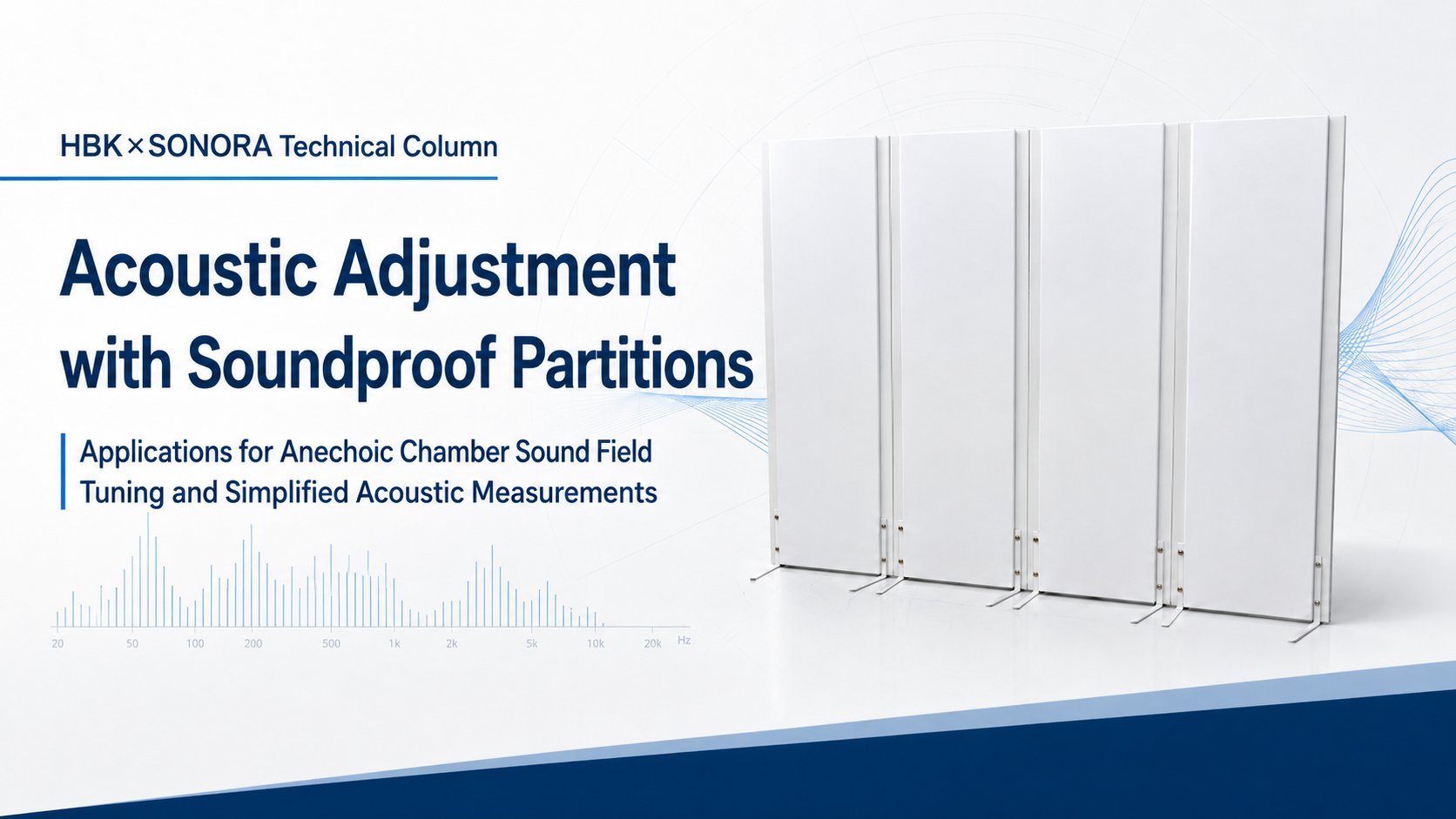
In acoustic measurements and room acoustic design, the reliability of the results depends not only on the performance of the instruments and analysis software, but also on the acoustic conditions of the measurement environment.
Even when high-precision microphones, sound level meters, data acquisition systems, and analysis software are used, the measured result may not represent only the sound radiated directly from the test object. Reflections and diffracted sound from walls, floors, ceilings, fixtures, jigs, furniture, and surrounding equipment can all influence the measurement.
In spaces such as meeting rooms, lecture rooms, web conference areas, control rooms, call centers, and communication areas in factories, sound pressure level alone is not always sufficient. It is also important to evaluate how clearly speech is transmitted. For this purpose, STI, or Speech Transmission Index, is widely used as an objective indicator of speech intelligibility.
Soundproof partitions can be used not only for general noise control, but also as movable acoustic adjustment elements. They are useful for controlling reflections during acoustic measurements, creating simplified measurement environments, tuning local sound fields in anechoic or hemi-anechoic rooms, and supporting the measurement, design, and construction of STI-oriented acoustic environments.
Using Soundproof Partitions as Acoustic Adjustment Elements
The term “soundproof partition” may suggest a simple barrier used to block noise in offices or factories.
However, from the perspective of acoustic measurement and room acoustic design, a soundproof partition is more than just a noise barrier. It can be used as a movable acoustic boundary to locally control reflected sound, diffracted sound, surrounding noise, and reverberation around a sound source or receiving position.
Typical applications include the following.
| Application | Purpose |
|---|---|
| Local sound field adjustment in anechoic and hemi-anechoic rooms | Reducing reflections from fixtures, test jigs, and surrounding equipment |
| Simplified acoustic measurements | Stabilizing measurement conditions in ordinary rooms or factory environments |
| Reduction of rear reflections from the sound source | Suppressing reflection paths from rear walls or jigs |
| Reduction of reflections behind the microphone | Reducing reflected sound arriving from behind the receiving position |
| Separation from surrounding noise | Reducing noise contribution from equipment other than the target source |
| STI environment design | Adjusting reflections, reverberation, background noise, and sound leakage that affect speech intelligibility |
| Acoustic improvement for web meetings and meeting rooms | Reducing reflected sound and ambient noise picked up by microphones |
SONORA soundproof partitions are self-supporting and can be installed without construction work. They are equipped with BFB acoustic panels on both sides, making it easier to control reflections on both the source side and the receiver side.
Influence of Reflected Sound in Acoustic Measurements
In acoustic measurements, a microphone receives not only the direct sound from the test object, but also sound reflected by surrounding boundaries and structures.
When the reflected component is significant, the measurement result can be affected in various ways.
| Acoustic issue | Influence on measurement results |
|---|---|
| Reflections from walls and floors | Peaks and dips may appear in the frequency response |
| Reflections from fixtures and test jigs | Local sound pressure increases may occur that are not caused by the test object itself |
| Noise from surrounding equipment | Background noise correction increases, resulting in greater measurement uncertainty |
| Reflections from behind the microphone | Sound pressure levels at the receiving point become unstable |
| Insufficient room dimensions | Near-field or reflected-field effects become more significant |
For example, if a hard wall or jig is located behind the test object, sound radiated backward from the source can be reflected and return toward the microphone. This reflected sound may interfere with the direct sound and create periodic peaks and dips in the frequency response.
In such cases, placing a soundproof partition behind the sound source can help reduce the influence of rear reflections and stabilize the measurement condition.
Local Sound Field Adjustment in Anechoic and Hemi-Anechoic Rooms
Anechoic and hemi-anechoic rooms are designed to provide a free field or a free field over a reflecting plane.
However, in practical measurements, the test object itself may be large, or the measurement space may include test jigs, frames, cables, pipes, cooling units, power supplies, turntables, doors, or access openings. These elements can generate local reflections, diffraction, and scattering.
By using soundproof partitions as temporary acoustic adjustment elements, it may be possible to reduce local reflection paths inside an anechoic or hemi-anechoic room and decrease variation among measurement points.
Typical Usage
| Position | Purpose |
|---|---|
| Behind the test object | Reducing reflections from rear walls, jigs, and support structures |
| Beside the test object | Suppressing lateral reflections and sound diffraction |
| Behind the microphone | Reducing reflected sound arriving from behind the receiving point |
| Between the test object and surrounding equipment | Reducing the contribution of noise from non-target equipment |
| Near doors or openings | Reducing local reflections and leakage path effects |
The key point is to use the soundproof partition not as a wall that completely blocks sound, but as a movable acoustic boundary for controlling reflection paths.
Applications in Simplified Acoustic Measurements
In many situations, acoustic measurements are performed not in anechoic or hemi-anechoic rooms, but in ordinary rooms, laboratories, or factory environments. This is common for early-stage development comparisons, on-site noise diagnostics, before-and-after evaluations of countermeasures, and relative evaluation of prototypes.
In such measurements, repeatability and comparability are often more important than absolute accuracy.
| Evaluation point | Purpose |
|---|---|
| Repeatability of measurement conditions | Enabling stable before-and-after or prototype comparisons |
| Signal-to-noise ratio | Separating the target sound from surrounding noise |
| Variation among measurement points | Reducing disturbance caused by local reflections |
| Reflected and diffracted sound | Reducing non-target acoustic contributions |
| Fixed layout conditions | Reproducing the same measurement condition repeatedly |
By using soundproof partitions, a simplified measurement area can be created around the test object. For measurements of small motors, fans, pumps, printers, servers, power supply units, and drive components, partitions placed behind or beside the test object can help reduce the influence of surrounding reflections and ambient equipment noise.
Setup Example: Reducing Rear Reflections from the Sound Source
This setup places soundproof partitions behind the test object to reduce reflections from the rear wall or test jig.
Typical Applications
- Noise measurement of small motors
- Comparative measurement of fans and pumps
- Sound pressure measurement of power supplies and server equipment
- Before-and-after evaluation of prototypes
Layout Concept
The direct sound path between the test object and the microphone is maintained, while the rear reflection path is suppressed by the soundproof partitions.
If periodic peaks and dips are observed in the frequency response, rear reflections may be affecting the measurement. In this case, changing the presence or position of the soundproof partitions and comparing the results can help identify the influence of rear reflections.
Layout Image
| Element | Arrangement |
|---|---|
| Test object | Radiates direct sound toward the microphone |
| Soundproof partitions | Placed behind the test object |
| Microphone | Positioned in front of the test object |
| Direct sound path | Maintained |
| Rear reflection path | Suppressed by the partitions |
Setup Example: Reducing Reflections Behind the Microphone
This setup places a soundproof partition behind the microphone to reduce reflected sound arriving from behind the receiving position.
Typical Applications
- Simplified sound pressure measurements in small rooms
- On-site measurements near walls
- Measurements in environments where operators or furniture are close to the microphone
- Prototype evaluations in ordinary rooms
Layout Concept
When reflections from a wall or furniture behind the microphone affect the measured value, placing an absorptive surface behind the receiving point can help stabilize the sound field at the microphone position.
This is particularly effective in ordinary rooms, where reflections from behind the microphone may affect measurement values in the mid- and high-frequency range.
Setup Example: L-Shaped or U-Shaped Arrangement Around the Test Object
Multiple soundproof partitions can be arranged in an L-shape or U-shape around the test object.
Typical Applications
- Equipment noise measurements in factory environments
- Measurements where surrounding equipment is operating
- Relative evaluation in early development stages
- Before-and-after evaluation of noise countermeasures
Layout Concept
By surrounding the rear and side areas of the test object with soundproof partitions, surrounding reflections and ambient noise intrusion can be reduced.
This does not create a complete free-field condition. However, it helps fix the measurement condition and improves repeatability in comparative measurements.
Application to STI Measurement, Design, and Environment Construction
The use of soundproof partitions is not limited to sound power measurements or simplified noise measurements. In meeting rooms, lecture rooms, web conference areas, control rooms, call centers, and factory communication areas, it is important to evaluate not only the sound pressure level but also how clearly speech is transmitted.
One objective indicator for evaluating speech transmission quality is STI, or Speech Transmission Index.
STI is influenced by multiple acoustic factors between the talker or loudspeaker and the listener.
| Factor | Influence on STI |
|---|---|
| Reverberation time | If too long, speech syllables overlap and intelligibility decreases |
| Early reflections | Can be beneficial within an appropriate range, but excessive reflections reduce clarity |
| Late reflections and reverberation | Blur the temporal modulation of speech and reduce intelligibility |
| Background noise | Reduces the signal-to-noise ratio of speech |
| Speech intrusion from adjacent areas | Reduces the ability to distinguish the target speech |
| Loudspeaker or talker position | Affects the balance between direct and reflected sound |
| Listener position | Speech intelligibility can vary significantly by location |
Soundproof partitions can be used to locally adjust these factors.
Using Soundproof Partitions in STI Environments
Improving STI is not simply a matter of adding more absorption. It is necessary to optimize the balance between direct sound, early reflections, reverberation, background noise, and diffracted sound along the speech transmission path.
Soundproof partitions can be used in the following ways.
| Usage | Purpose |
|---|---|
| Behind the talker or loudspeaker | Reducing rear reflections and improving speech clarity |
| Behind the listener position | Reducing reflected sound arriving from behind the listener |
| Partial enclosure of a meeting area | Reducing surrounding noise and speech intrusion from adjacent areas |
| Acoustic adjustment of web conference booths | Reducing reflected sound and ambient noise picked up by microphones |
| Creation of communication zones in factories | Improving speech transmission under machinery noise |
| Before-and-after evaluation | Confirming STI improvement by changing partition placement |
For example, in a web conference space, the talker’s voice may be loud enough, but reflections and surrounding noise picked up by the microphone can reduce intelligibility for remote participants. Placing soundproof partitions behind or beside the talker can reduce reflected sound and ambient noise entering the microphone, which may improve speech clarity.
In factory communication areas, machinery noise can reduce the signal-to-noise ratio of speech. By using soundproof partitions to partially separate the communication zone, the target speech can be better separated from surrounding noise.
Procedure for STI Measurement and Acoustic Design
When designing an STI-oriented acoustic environment, the following process is useful.
1. Survey the Existing Conditions
Identify the room usage, talker positions, listener positions, loudspeaker locations, background noise sources, reflective surfaces, and subjective reverberation characteristics.
For meeting rooms, check listening conditions at each seating position, microphone locations for web meetings, and loudspeaker placement. In factory environments, identify machinery noise sources, worker positions, and the direction of verbal instructions.
2. Measure STI
Measure STI at the target positions to quantitatively evaluate speech transmission quality. If necessary, also evaluate sound pressure level, background noise, reverberation time, and frequency response.
3. Estimate Reflection and Noise Paths
Determine whether the main cause of reduced STI is reverberation, background noise, specific reflections, or speech intrusion from surrounding areas.
4. Temporarily Install Soundproof Partitions
Temporarily place soundproof partitions behind the talker, behind the listener position, at the sides, or between the target area and noise sources to adjust reflected sound and surrounding noise.
5. Re-measure and Compare
Compare STI, sound pressure level, background noise, reverberation characteristics, and frequency response before and after partition installation.
6. Develop Permanent Countermeasures
After confirming the effect using movable partitions, permanent countermeasures can be considered. These may include fixed absorptive panels, soundproof walls, acoustic booths, ceiling or wall absorption, and changes to loudspeaker placement.
Double-Sided Absorptive Structure with BFB Acoustic Panels
SONORA soundproof partitions use BFB acoustic panels on both sides.
BFB is an interior acoustic panel made by framing glass wool board with DuPont™ Tyvek®. Since the Tyvek® surface material allows air to pass through, the sound absorption performance of the glass wool backing can be effectively used. The structure also takes durability, water resistance, and appearance into consideration.
For acoustic measurements and STI environment adjustment, having absorptive surfaces on both sides is important.
With single-sided absorption, reflections on the source side may be reduced, but reflections on the receiver side or outer side may remain. In contrast, a double-sided absorptive structure can reduce reflected sound on both sides of the partition and provide acoustic adjustment effects on both the source side and the receiver side.
Points to Check Before Use
When using soundproof partitions for acoustic measurements or STI environment design, the following points should be checked.
| Check point | Description |
|---|---|
| Measurement purpose | Absolute evaluation, relative comparison, screening, or STI evaluation |
| Target frequency range | Whether low frequencies or mid-to-high frequencies are dominant |
| Source position | Point-like source, surface source, or multiple sources |
| Microphone position | Whether it is affected by reflections from walls, floors, or furniture |
| Listener position | Whether the measurement position corresponds to the actual listening position |
| Background noise | Whether it is sufficiently low compared with the target sound or speech |
| Reflection paths | Whether rear, side, ceiling, or floor reflections are dominant |
| Reverberation | Whether it is long enough to reduce speech intelligibility |
| Layout repeatability | Whether the partition position can be reproduced each time |
For STI evaluation in particular, the goal is not simply to reduce sound level. It is important to maintain the direct sound required for speech transmission while reducing unnecessary reflections, reverberation, and background noise.
Specifications and Example Measurement Result
SONORA soundproof partitions have a self-supporting structure with dimensions of W500 × L80 × H1500 mm and a weight of approximately 8 kg. The main components are BFB acoustic panels, plywood, and steel legs. They can be used for local noise control in factories and workspaces, various acoustic adjustment tasks, reverberant noise reduction, and simplified sound insulation and absorption in laboratories, inspection rooms, and measurement rooms.
In an example measurement conducted in a SONORA hemi-anechoic room with four partitions arranged in parallel, an A-weighted overall level difference of 12.4 dB was confirmed. Frequency-specific level differences were 14.9 dB at 500 Hz, 10.3 dB at 1 kHz, 12.9 dB at 2 kHz, and 12.5 dB at 4 kHz.
These values are examples obtained under specific measurement conditions. Actual performance will vary depending on the frequency characteristics of the sound source, the number and arrangement of partitions, gaps, diffraction from the floor, ceiling, and sides, and the reverberation characteristics of the room.
Summary
Soundproof partitions can be used not only as general noise control products, but also as movable acoustic adjustment elements for acoustic measurement and room acoustic design.
In anechoic and hemi-anechoic rooms, they can help reduce local reflections caused by jigs, frames, surrounding equipment, and openings. In ordinary rooms and factory environments, they can support simplified acoustic measurements by improving reflection control, signal-to-noise ratio, and repeatability.
They can also be used for STI measurement, speech intelligibility improvement, and acoustic design in meeting rooms, lecture rooms, web conference spaces, and factory communication areas. By temporarily installing soundproof partitions and comparing measurement results before and after layout changes, it is possible to quantitatively examine the direction of permanent acoustic countermeasures before construction.
Moritani provides acoustic measurement and acoustic design solutions by combining measurement instruments, acoustic test environments, and absorption and sound insulation technologies. We support measurement, evaluation, acoustic adjustment, and countermeasure planning according to each application.
Related Links
Latest Posts in Technical Column
-

2026.10.21
Why Quieter Appliances Make Abnormal Noise More Noticeable | Masking and Sound Quality -
2026.10.07
Is It Okay to Measure Noise with a Smartphone? Limitations of Smartphone Noise Meters and Differences from B&K 2245 -

2026.09.30
Differences Between Free-Field, Pressure-Field, and Random-Incidence Microphones: How to Choose and Use Them for Your Measurement Space -
2026.08.03
Why Are Anechoic Chamber Walls Spiky? How Acoustic Wedges Work -
2026.07.28
White Noise vs Pink Noise vs Sweep Signals -
2026.07.13
Acoustic Adjustment with Soundproof Partitions ― Applications for Anechoic Chamber Tuning, Simplified Acoustic Measurements, and STI Environment Design ― -
2026.07.08
Why HBK × SONORA? ― The Benefits of Integrating Acoustic Instrumentation and Acoustic Test Environments ― -

2026.05.18
Misconceptions About a Sound Absorption Coefficient of 0.99 ― How ISO 3745:2012 Changed the Philosophy of Anechoic Room Evaluation ― -
2026.05.13
How to Use HATS ― Operating a Measurement System That Reproduces the Human Head and Ears Within the Framework of Standards and Acoustic Environments ― -
2026.04.13
Evaluation Methods in Building Acoustics: Streamlining Field Measurements and Material Assessment in Laboratory Environments

Contact Us
- Contact us by email
-
- Contact us by phone
-
Moritani Shokai
(Machinery Department No. 2, Tokyo Head Office)


Introduction of the Manufacturer
-

Hottinger Bruel & Kjaer
HHBK is a merger of two companies: Brüel & Kjær of Denmark and HBM of Germany.
Brüel & Kjær is one of the world’s leading manufacturers of acoustic and vibration measurement instruments, known as a total measurement chain supplier.Learn more about HBK
-
Sonora Technology Co., Ltd.
Sonora Technology is a leading Japanese manufacturer of industrial anechoic chambers and anechoic boxes.
From design and manufacturing to installation and acoustic performance assurance, Sonora provides fully integrated solutions to build complete acoustic measurement environments from the ground up.Learn more about Sonora

Contact / Request Brochure
For inquiries or consultations regarding the total solutions provided by HBK × Sonora, please feel free to contact us using the Contact button.
If you would like a brochure sent by mail, please use the Request Brochure button.