

Technical Column
Why HBK × SONORA? ― The Benefits of Integrating Acoustic Instrumentation and Acoustic Test Environments ―
Jul 8, 2026
- HBK × SONORA Acoustic Measurement Solution Official Website
- Technical Column
- Why HBK × SONORA? ― The Benefits of Integrating Acoustic Instrumentation and Acoustic Test Environments ―
Acoustic Power Measurement
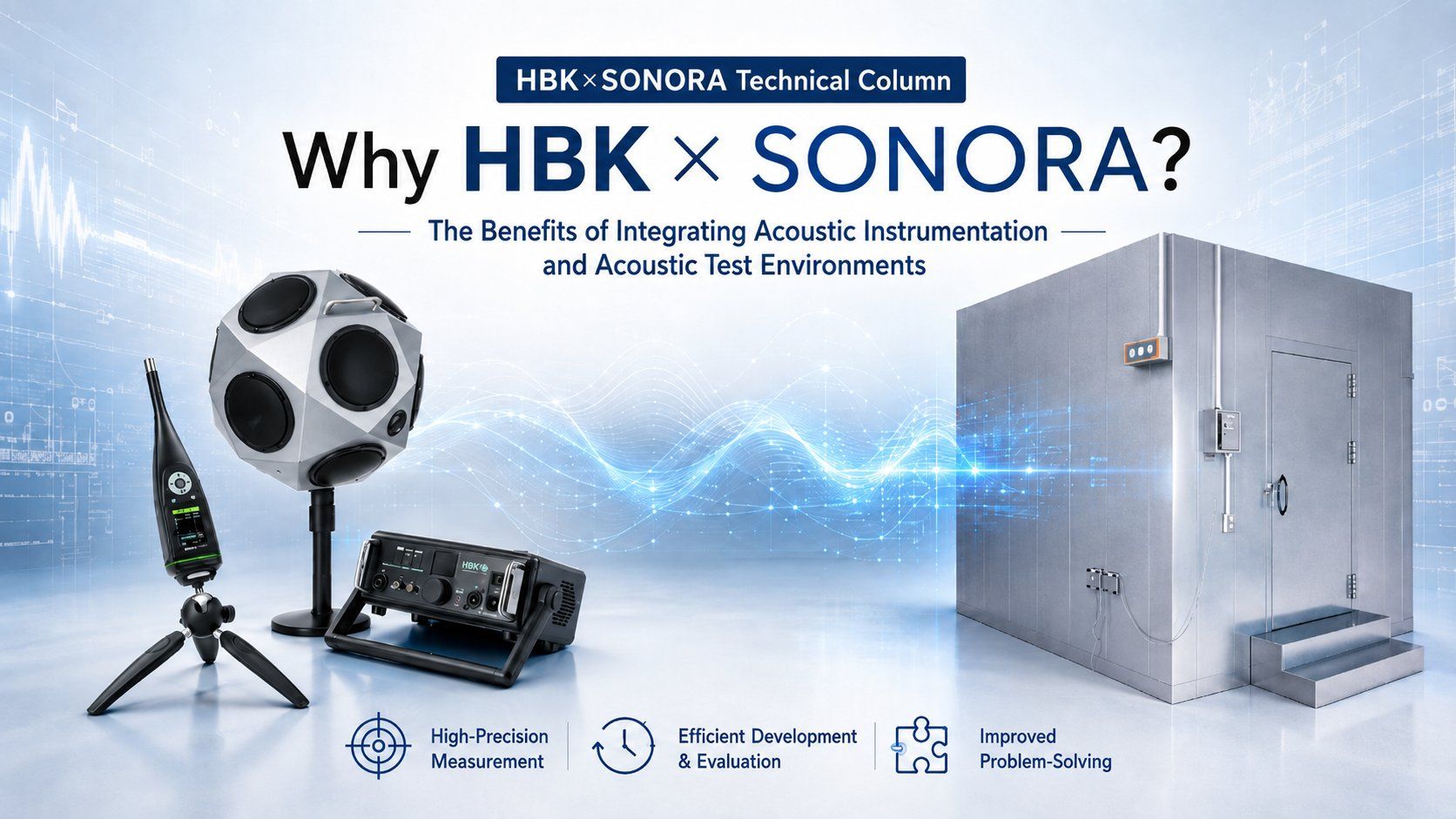
In acoustic measurement, the reliability of the results depends not only on the accuracy of the instruments, but also on the performance of the measurement environment.
Even when high-precision microphones, sound level meters, data acquisition systems, and analysis software are used, the measurement results can still be affected by reflected sound, background noise, floor vibration, external noise, HVAC noise, and reflections from fixtures or test jigs.
On the other hand, even if a high-performance anechoic room or anechoic box is introduced, the performance of the acoustic space cannot be fully utilized unless the measurement instruments, microphone arrangement, analysis conditions, standard compliance, calibration, and data processing are properly designed.
In other words, the quality of acoustic measurement cannot be achieved by instrumentation alone, nor by the measurement space alone.
It is essential to design the test object, applicable standards, measurement system, acoustic environment, fixtures, analysis method, and operation procedure as one integrated system.
HBK × SONORA is an acoustic measurement solution that integrates both “measurement” and “space.”
HBK provides technologies for acoustic and vibration measurement, including measuring instruments, analysis systems, microphones, and sound level meters. SONORA designs and manufactures acoustic test environments such as anechoic rooms, hemi-anechoic rooms, anechoic boxes, soundproof rooms, and acoustic interiors. Moritani combines these capabilities and supports customers from system configuration and proposal through implementation and operation.
The HBK × SONORA official website introduces total solutions that combine acoustic measurement systems with full anechoic rooms, hemi-anechoic rooms, and anechoic boxes for applications such as sound power measurement, electroacoustic measurement, simplified performance testing, sound source localization, pass-by noise measurement, and automated acoustic inspection.
Common Challenges in Acoustic Measurement
In actual acoustic measurement environments, the following issues frequently occur.
| Challenge | Typical Situation |
|---|---|
| Measurement values are unstable | Results vary each time the measurement is performed |
| Peaks and dips appear in frequency response | Influenced by wall reflections or fixture reflections |
| Background noise is high | Noise from surrounding equipment, HVAC, or external sources contaminates the measurement |
| Compliance with standards is difficult to judge | Relationship with ISO, JIS, or internal standards is unclear |
| Anechoic room is introduced but not fully utilized | Instruments, fixtures, and analysis conditions are not properly aligned |
| Measurement instruments are available but the environment is insufficient | Measurements are performed in ordinary rooms where reflections and noise are significant |
| Difficult to expand to production inspection | Issues remain in measurement time, handling, automatic judgment, and data storage |
These issues are often difficult to solve by looking only at the instruments or only at the measurement room.
For example, when irregularities appear in the frequency response, it is necessary to determine whether the cause is the microphone, the analyzer, room reflections, the fixture, or background noise.
The advantage of HBK × SONORA is that these issues can be examined from both the measurement-system side and the acoustic-space side.
Benefit 1: System Configuration Can Be Determined from the Measurement Purpose
Acoustic measurement has many different purposes.
The required instruments and acoustic environment differ depending on whether the objective is to measure sound power level according to standards, evaluate electroacoustic devices such as loudspeakers or headphones, compare product noise in a factory environment, perform sound source localization, evaluate vehicle pass-by noise, or automate inspection on a production line.
With HBK × SONORA, the necessary measurement system and acoustic environment can be selected by working backward from the measurement purpose.
Main solution examples include the following.
| Measurement Purpose | Example Configuration |
|---|---|
| Sound power measurement | Acoustic measurement system + full anechoic room / hemi-anechoic room |
| Electroacoustic measurement | Acoustic measurement system + anechoic box / full anechoic room / hemi-anechoic room |
| Simplified performance testing | Sound level meter + anechoic box |
| Sound source measurement and localization | Acoustic Camera + anechoic room |
| Pass-by noise measurement | VSAC + pass-by measurement system |
| Production-line acoustic inspection | Automatic-door anechoic box + high-precision analysis and automatic judgment system |
By clarifying the measurement purpose at the beginning, it is possible to avoid excessive investment while selecting a configuration that satisfies the required accuracy and operability.
Benefit 2: Measurement Environments Can Be Designed with Standards Compliance in Mind
In acoustic measurement, compliance with ISO, JIS, or customer-specific standards may be required.
For example, in sound power measurement, the required environmental conditions, microphone arrangement, background noise condition, environmental correction, and measurement surface differ depending on the measurement method, such as the sound pressure method or the sound intensity method.
For sound power measurement, HBK × SONORA solutions support standards such as JIS Z 8732, JIS Z 8733, ISO 3744, and ISO 3745. For sound intensity methods, JIS Z 8736-1, -2, -3 and ISO 9614-1, -2, -3 are also applicable.
For standards compliance, it is not enough to simply prepare the measurement instruments.
It is also necessary to examine whether the measurement space satisfies the requirements of the standard, whether background noise is sufficiently low, whether the test object can be properly positioned, whether the required measurement surface can be secured, and how the influence of fixtures and floor surfaces should be handled.
HBK × SONORA enables simultaneous consideration of the measurement standards, test object, target frequency range, measurement surface, operation method, measurement system, and acoustic space.
Benefit 3: The System Can Be Designed Up to the Point Where It Is Actually Ready to Measure
In acoustic measurement facilities, introducing instruments or constructing a room does not automatically mean stable measurements can be performed immediately.
In practice, the following operational conditions must also be designed.
| Item | Points to Consider |
|---|---|
| Microphone arrangement | Placement according to standards, test object size, and measurement distance |
| Measurement fixtures | Effects on reflection, vibration, fixation method, and repeatability |
| Background noise management | HVAC, surrounding equipment, external noise, and floor vibration |
| Measurement procedure | Pre-test check, calibration, background noise measurement, and target sound measurement |
| Data management | Analysis conditions, file formats, and traceability |
| Workability | Loading/unloading, door operation, fixture replacement, and measurement time |
| Future expandability | Larger test objects, wider frequency range, and automation support |
SONORA is introduced as a manufacturer that provides integrated solutions for anechoic rooms and anechoic boxes, covering design, manufacturing, installation, and acoustic performance verification.
By combining this with HBK measurement instruments and analysis systems, the facility can be planned not only as a completed measurement room, but also as a practical measurement system designed around “what to measure, how to measure it, and at what level of accuracy.”
Benefit 4: Step-by-Step Planning from Simplified Measurement to Full-Scale Measurement
Not every measurement requires a large anechoic room or advanced automated inspection system from the beginning.
In the early development phase, it may be sufficient to perform simple comparative measurements of product noise. Before mass production, it may be necessary to stabilize the measurement conditions and establish pass/fail criteria. For standard-compliant testing or external quality assurance, measurement in a full anechoic room or hemi-anechoic room may be required.
HBK × SONORA allows customers to plan systems step by step, from simplified measurement to full-scale measurement.
For example, simplified performance testing using an anechoic box and a sound level meter enables sound pressure measurement with minimal setup time. With a recording option, captured waveforms can also be analyzed in detail on a PC. Example applications include automotive components, electrical devices, transmissions, gears, motors, fans, and air conditioners.
The ability to expand from anechoic boxes and simplified testing to anechoic rooms, sound source localization, and automated inspection according to application and development phase is a major benefit for users.
Benefit 5: Sound Source Localization and Root-Cause Analysis Can Be Connected
In noise countermeasures, knowing that “the sound is loud” is not enough to proceed with effective improvement.
It is necessary to identify where the sound is generated, which frequency range is problematic, and which part or structure contributes to the noise.
HBK × SONORA also provides solutions that combine Acoustic Cameras with anechoic rooms for sound source measurement and localization. By using sound source localization equipment inside an anechoic room, it is possible to visually identify the location and magnitude of sound sources in an environment where the influence of sound reflections and external noise is reduced.
This is particularly important in development work.
Instead of simply performing pass/fail evaluation, engineers can understand the mechanism of noise generation and use the results for design improvement and countermeasure planning.
Benefit 6: Expansion to Automated Acoustic Inspection in Production Lines
Acoustic measurement is not limited to R&D departments.
Depending on the product, abnormal sound, noise, operating sound, and sound quality must also be inspected on production lines.
In this case, measurement accuracy is not the only issue.
| Challenge in Production Inspection | Required Response |
|---|---|
| Factory noise | Sound-insulated and vibration-isolated measurement environment |
| Measurement time | Automation of loading, door operation, measurement, and judgment |
| Judgment criteria | Analysis of frequency characteristics, sound pressure, abnormal sound components, etc. |
| Data storage | Ensuring traceability |
| Equipment integration | Integration with conveyors, PLCs, and factory automation equipment |
| Maintainability | Structure and maintenance suitable for long-term operation |
HBK × SONORA solutions include production-line automated acoustic inspection systems that combine automatic-door anechoic boxes with high-precision analysis and automatic judgment systems.
These systems are designed to integrate with existing production and conveying equipment, automating loading, unloading, door operation, measurement, and judgment. Their sound-insulating and vibration-isolating structures also help reduce the influence of factory noise and floor vibration, supporting high-precision measurement that is less affected by the surrounding environment.
Being able to connect acoustic measurement from development evaluation to production inspection using the same concept is a major advantage for quality management.
Benefit 7: A Single Consultation Point
Introducing acoustic measurement facilities often involves many stakeholders, including measurement instrument manufacturers, test room manufacturers, fixture manufacturers, construction companies, facility contractors, production engineering departments, and quality assurance departments.
When these elements are handled separately, the following issues can occur.
| Issue with Separate Procurement | Description |
|---|---|
| Responsibility becomes unclear | It is difficult to determine whether measurement variation comes from instruments or the environment |
| Specification coordination takes time | Instruments, rooms, fixtures, and handling systems must be aligned |
| Over- or under-specification may occur | The system may become unnecessarily expensive or insufficient in performance |
| Operational issues appear after installation | Measurement procedures, data processing, and maintenance may be considered too late |
Moritani operates the HBK × SONORA acoustic measurement solution website and serves as the contact point through its Tokyo Head Office Machinery Department No. 2.
For users, a major advantage is that acoustic measurement instruments and acoustic test environments can be discussed together according to the measurement purpose, rather than being considered separately.
Suitable Users and Applications
HBK × SONORA solutions are suitable for users with the following needs.
| User Need | Suitable Proposal |
|---|---|
| Measure product noise according to standards | Sound power measurement system + anechoic room / hemi-anechoic room |
| Compare noise from small parts simply | Sound level meter + anechoic box |
| Evaluate loudspeakers or headphones | Electroacoustic measurement system + anechoic box / anechoic room |
| Identify noise source locations | Acoustic Camera + anechoic room |
| Evaluate vehicle noise | VSAC + pass-by measurement system |
| Automate abnormal sound inspection on production lines | Automatic-door anechoic box + automatic judgment system |
| Improve speech intelligibility in meeting rooms or web conference environments | STI measurement + acoustic adjustment / absorption and sound insulation planning |
| Improve measurement accuracy of existing facilities | Current-condition diagnosis + sound field adjustment + review of measurement conditions |
The key point is not to decide on product names or equipment specifications first.
Instead, it is important to clarify what needs to be measured, at what accuracy, at what frequency, and in what environment.
Recommended Procedure for System Planning
For integrated solutions such as HBK × SONORA, the following process helps create a well-balanced facility plan without excessive or insufficient specifications.
1. Clarify the Measurement Purpose
First, clarify what needs to be measured.
The required configuration differs depending on whether the target is sound pressure level, sound power level, frequency response, abnormal sound, sound source location, STI, speech recognition performance, or production inspection.
2. Define the Test Object
Confirm the dimensions, weight, sound level, frequency range, operating conditions, loading method, and fixation method of the test object.
3. Confirm Required Accuracy and Standards
Check which standards or requirements must be satisfied, such as ISO, JIS, internal standards, or customer requirements.
4. Examine the Measurement Space
Select the appropriate space according to the application, such as a full anechoic room, hemi-anechoic room, anechoic box, soundproof room, existing room modification, or simplified measurement booth.
5. Examine the Measurement System
Select microphones, sound level meters, data acquisition systems, analysis software, Acoustic Cameras, automatic judgment systems, and other required equipment.
6. Consider the Operation Method
Determine whether measurements will be performed manually or automatically, how data will be stored and judged, and whether the system must support future changes in target products.
7. Verify After Installation
After installation, confirm background noise, reflections, measurement repeatability, measurement procedures, data output, and maintainability so that the system is ready for stable operation.
Summary
The reliability of acoustic measurement is not determined by instrument performance alone.
Stable measurement becomes possible only when the measurement space, background noise, reflections, fixtures, layout, analysis conditions, and operation method are designed together.
The strength of HBK × SONORA is that acoustic measurement instruments and acoustic test environments can be considered as one integrated solution. From simplified testing to standard-compliant measurement, sound source localization, STI evaluation, and production-line automated inspection, the system configuration can be developed step by step according to the measurement purpose.
Moritani proposes acoustic measurement solutions that combine measurement instruments, acoustic test environments, analysis, and automation according to the test object, measurement purpose, installation environment, applicable standards, and operating method.
Related Links
Latest Posts in Technical Column
-

2026.09.30
Differences Between Free-Field, Pressure-Field, and Random-Incidence Microphones: How to Choose and Use Them for Your Measurement Space -
2026.08.03
Why Are Anechoic Chamber Walls Spiky? How Acoustic Wedges Work -
2026.07.28
White Noise vs Pink Noise vs Sweep Signals -
2026.07.13
Acoustic Adjustment with Soundproof Partitions ― Applications for Anechoic Chamber Tuning, Simplified Acoustic Measurements, and STI Environment Design ― -
2026.07.08
Why HBK × SONORA? ― The Benefits of Integrating Acoustic Instrumentation and Acoustic Test Environments ― -

2026.05.18
Misconceptions About a Sound Absorption Coefficient of 0.99 ― How ISO 3745:2012 Changed the Philosophy of Anechoic Room Evaluation ― -
2026.05.13
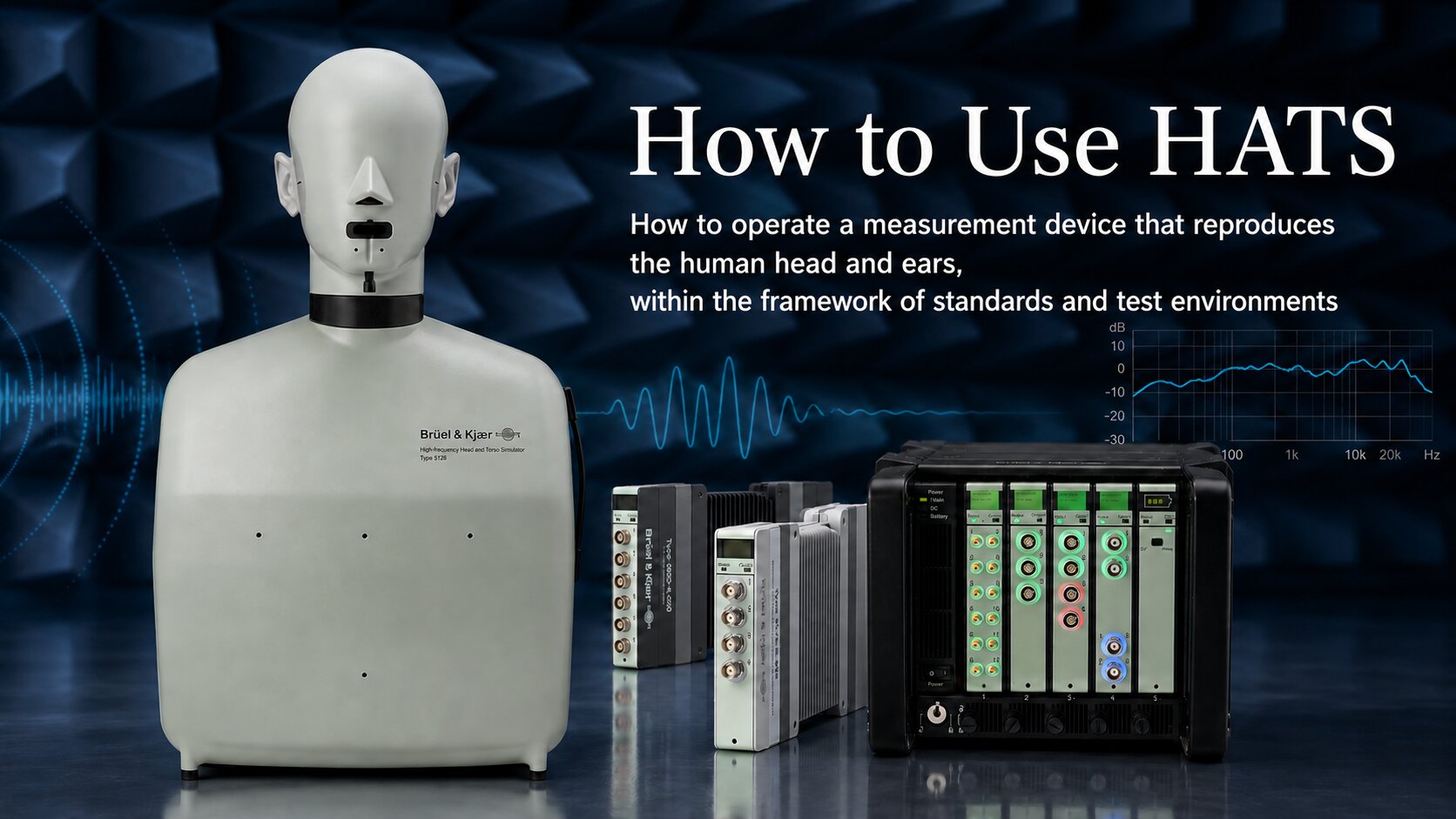
How to Use HATS ― Operating a Measurement System That Reproduces the Human Head and Ears Within the Framework of Standards and Acoustic Environments ― -
2026.04.13
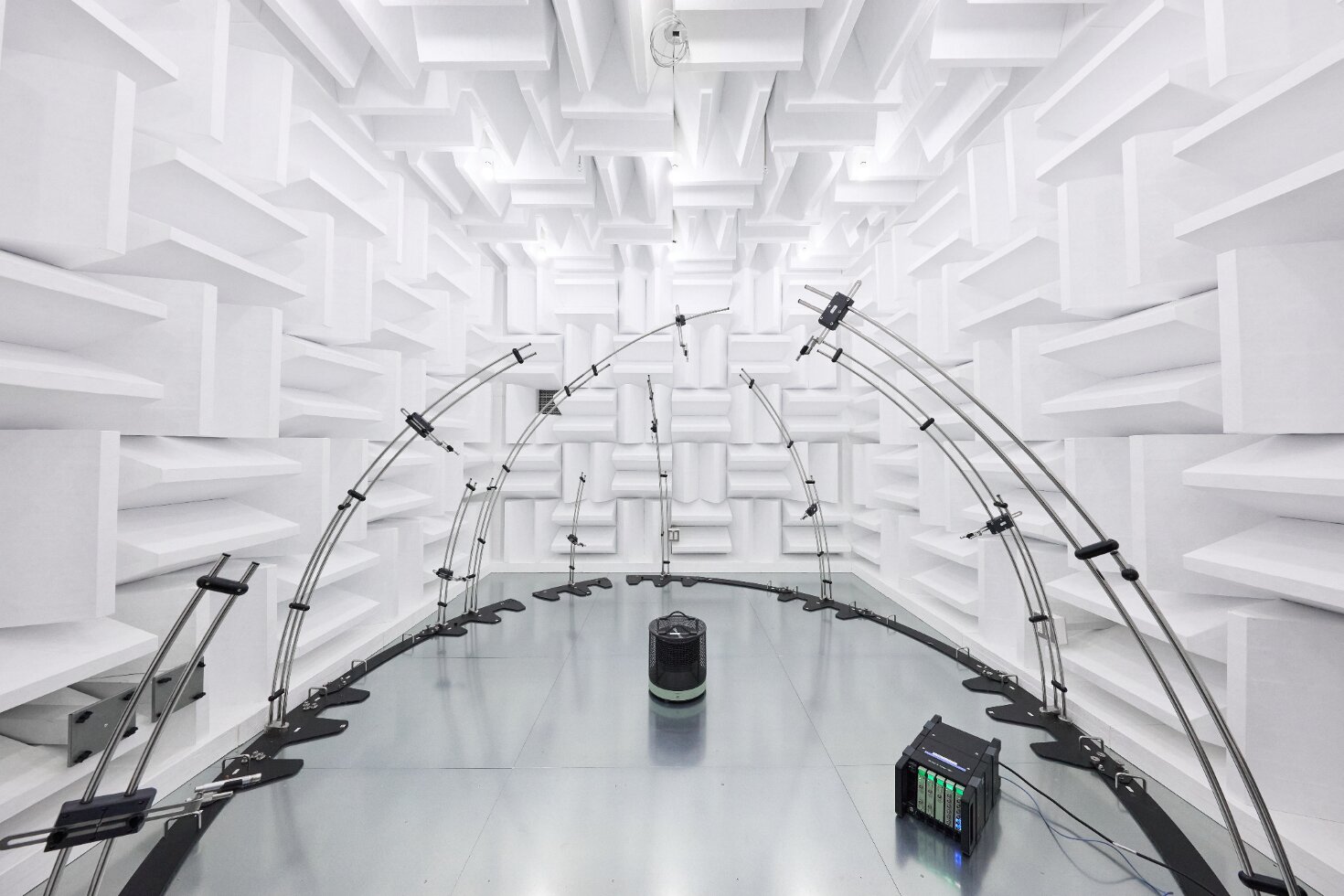
Evaluation Methods in Building Acoustics: Streamlining Field Measurements and Material Assessment in Laboratory Environments -
2026.03.23
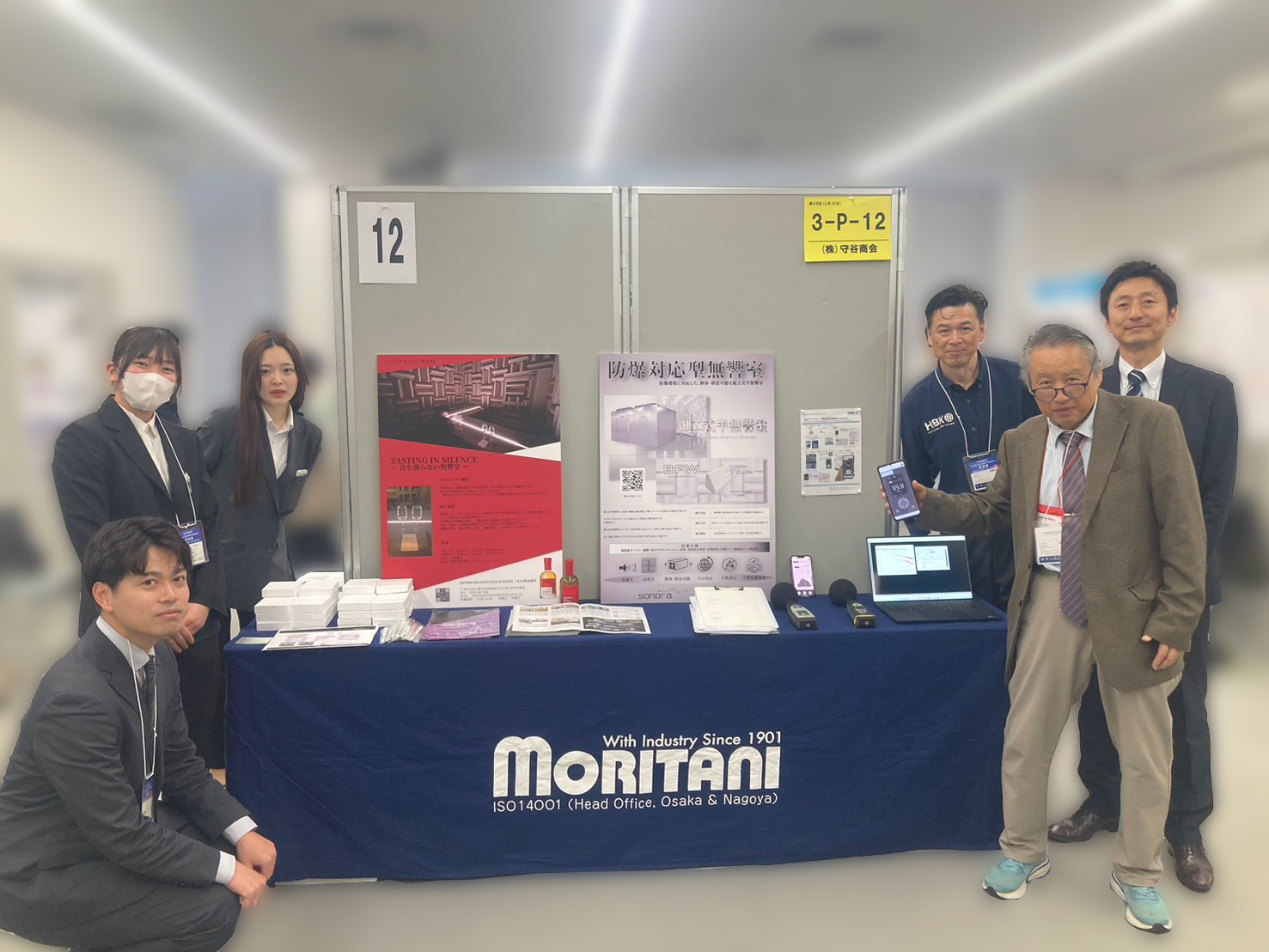
We participated in the corporate exhibition at the Acoustical Society of Japan (ASJ) Meeting on March 19, 2026 -
2026.03.10
How to Read Standards Related to Anechoic Chambers ― Organizing Sound Power Measurement Standards and Qualification of Test Environments ―

Contact Us
- Contact us by email
-
- Contact us by phone
-
Moritani Shokai
(Machinery Department No. 2, Tokyo Head Office)


Introduction of the Manufacturer
-

Hottinger Bruel & Kjaer
HHBK is a merger of two companies: Brüel & Kjær of Denmark and HBM of Germany.
Brüel & Kjær is one of the world’s leading manufacturers of acoustic and vibration measurement instruments, known as a total measurement chain supplier.Learn more about HBK
-
Sonora Technology Co., Ltd.
Sonora Technology is a leading Japanese manufacturer of industrial anechoic chambers and anechoic boxes.
From design and manufacturing to installation and acoustic performance assurance, Sonora provides fully integrated solutions to build complete acoustic measurement environments from the ground up.Learn more about Sonora
Contact / Request Brochure
For inquiries or consultations regarding the total solutions provided by HBK × Sonora, please feel free to contact us using the Contact button.
If you would like a brochure sent by mail, please use the Request Brochure button.