

Technical Column
Why Quieter Appliances Make Abnormal Noise More Noticeable | Masking and Sound Quality
Oct 21, 2026
- HBK × SONORA Acoustic Measurement Solution Official Website
- Technical Column
- Why Quieter Appliances Make Abnormal Noise More Noticeable | Masking and Sound Quality
Simplified Performance Testing Using Anechoic Box + Sound Level Meter
Introduction: quieter does not always mean less noticeable
Refrigerators, washing machines, air purifiers and other home appliances get quieter every year thanks to better motors, optimized fan shapes and vibration-isolating structures.
Yet when the operating noise of a product is reduced, users sometimes report that a high-pitched whine or a faint clicking sound has become more bothersome than before. That does not necessarily mean a new defect has appeared. A more likely explanation is that a component previously hidden behind other sounds has been exposed by the noise reduction.
The key to understanding this is the masking effect of human hearing. This article explains how audibility changes, how sound quality is evaluated, and why low-level sounds are measured in anechoic chambers and anechoic boxes.
1. Why does abnormal noise stand out when a product gets quieter?
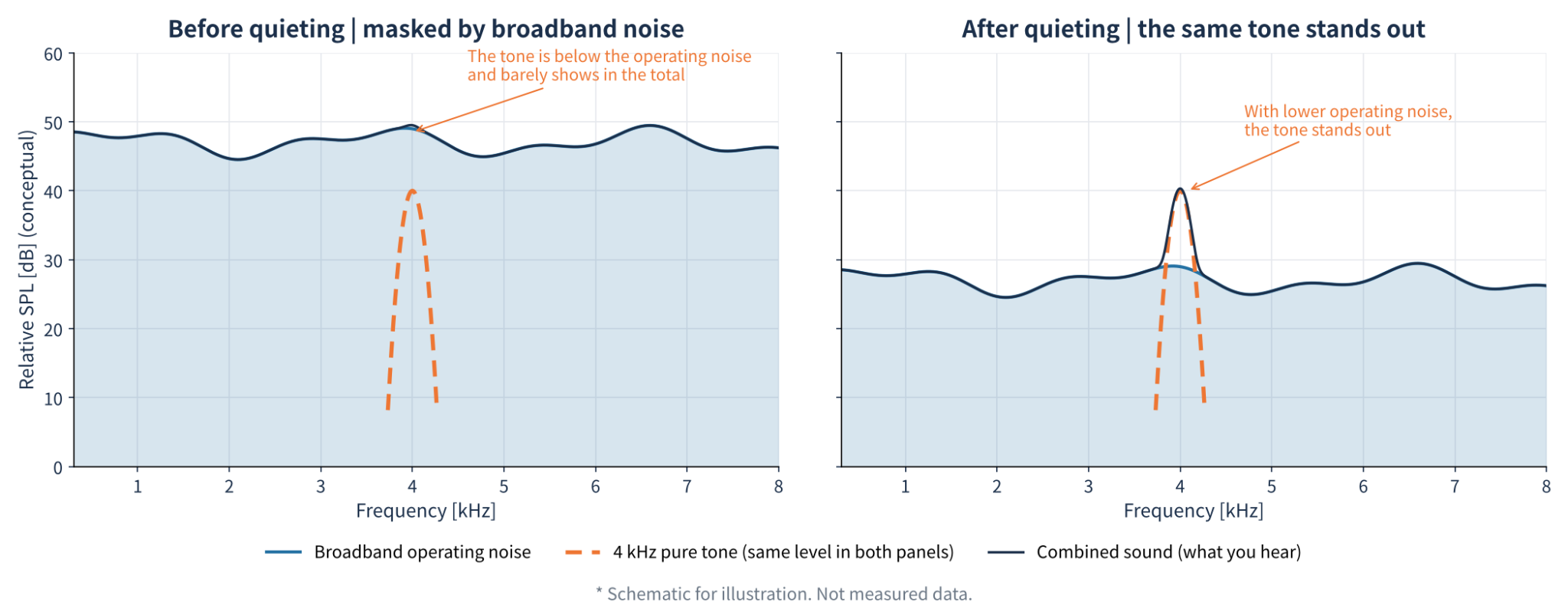
Take an air purifier as an example. The whooshing airflow noise from the fan is spread over a wide frequency band and covers the narrow-band whine from the motor. When an improved fan lowers the airflow noise, the motor whine becomes audible even though its own level has not changed.
| Before quieting | the broadband operating noise is loud, and narrow-band sounds are buried in it. |
|---|---|
| After quieting | the broadband operating noise drops, and specific frequency components and intermittent sounds stand out. |
2. What is the masking effect?
Masking is an auditory phenomenon in which the presence of one sound makes another sound harder to hear. In a quiet room you can hear the second hand of a clock, but once the ventilation fan is switched on, you no longer can. The clock has not become quieter; your ears simply find it harder to detect.
Masking is strongest when the masking sound and the masked sound are close in frequency. Low-frequency sounds also tend to mask a wide range of higher frequencies. Besides simultaneous masking between sounds that occur at the same time, there is also temporal (non-simultaneous) masking, in which a quiet sound just before or after a loud one becomes harder to hear.
In other words, what we hear depends on the combination of each component’s level, frequency band, duration and timing. A drop in the surrounding sound does not make every abnormal noise stand out.
3. A lower dB value does not always mean a better impression
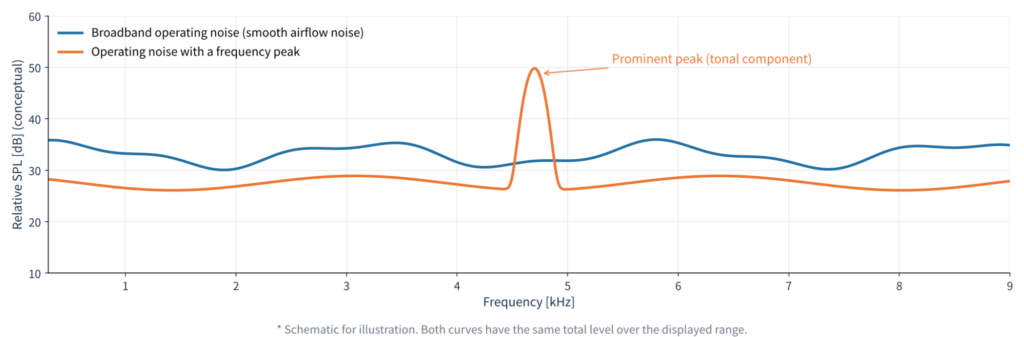
The A-weighted sound pressure level LpA [dB] is widely used to compare how loud operating noise is. However, a smooth airflow noise and an operating noise containing a sharp beep can sound completely different even at the same level.
One reason is how the sound energy is distributed across frequency. A component concentrated at a specific frequency is perceived as a tonal sound with a pitch. Intermittent impacts and periodic fluctuations also draw the ear’s attention. A single number such as the A-weighted level does not capture these characteristics.
Typical metrics used in sound quality evaluation
| Metric | What it describes | Unit | Main standards |
|---|---|---|---|
| Loudness | Perceived loudness of a sound | sone | ISO 532-1, ISO 532-2, ECMA-418-2 |
| Tonality | How prominent the pitched components are | tu | ECMA-418-2 (prominent discrete tones: ECMA-418-1) |
| Sharpness | How sharp or shrill a sound is | acum | DIN 45692 |
| Roughness | Grating impression from fast modulation; modulation frequency roughly 15–300 Hz (maximum around 70 Hz) | asper | ECMA-418-2 |
| Fluctuation strength | Wavering impression from slow modulation; modulation frequency roughly 20 Hz or below (maximum around 4 Hz) | vacil | ECMA-418-2 |
Combining these psychoacoustic metrics with FFT analysis, time waveforms, spectrograms and actual listening tests makes it possible to examine from several angles which sounds changed, and how, as a result of noise reduction. No single metric, however, determines how comfortable a product sounds.
4. Examples of sounds from home appliances
| Refrigerators | hum from the compressor and fans, pipe vibration, creaking of parts expanding and contracting with temperature changes |
|---|---|
| Washing machines | rotational noise from the motor, drum and bearings, cabinet vibration, contact noise between parts |
| Air purifiers | noise from the fan and motor, airflow noise generated in the air path |
| Vacuum cleaners | rotational components from the motor and fan, airflow noise around the suction inlet |
Similar sounds can be normal operating noise, or they can indicate wear, poor mounting or resonance that needs attention. Rather than judging a fault by sound alone, it is important to compare with a reference unit and to measure under consistent conditions.
5. Measuring low-level abnormal noise: control background noise and reflections
Ordinary laboratories and factories have background noise from air conditioning, nearby machinery and people. When the sound being measured is quiet, background noise overlaps the measurement signal and the target components can no longer be separated. The smaller the difference between the background noise and the target sound, the more the measured value is affected by the background noise. (The background noise correction in ISO 3745 is also discussed in “Can We Create “Absolute Silence” on Earth?“)
Sound reflected from the walls and ceiling of a room also affects the results. When evaluating low-level sounds, a low-background-noise environment and control of reflections must be considered together, matched to the level and frequency of the target sound and to the measurement method.
A point that is easily overlooked is the noise of the measurement equipment itself. Even if the background noise of the measurement space is reduced, low-level sounds cannot be measured if the inherent (self-) noise of the microphone or instrument is higher than the target sound. Low-level noise measurement calls for instruments with low self-noise, such as low-noise microphones, selected together with a measurement space that has low background noise. A setup combining an anechoic box with the HBK Type 4955-A low-noise microphone is introduced in “Simplified Performance Testing with Anechoic Box + Sound Level Meter.”
The role of anechoic and semi-anechoic chambers
An anechoic chamber blocks sound entering from outside and suppresses reflections from its walls, ceiling and floor with sound absorption. A semi-anechoic chamber keeps the floor as a reflecting surface and is used to measure products that stand on the floor. When measuring sound power levels, it is important that the chamber meets the sound field conditions required by the applicable standard.
The role and limits of anechoic boxes
For abnormal noise inspection of small motors, fans, gears and electronic components, an anechoic box that keeps out external noise is also a strong option. On production lines, an anechoic box with an automatic door can automate everything from loading to measurement and judgment (Auto-door anechoic box).
However, the inside of an anechoic box does not necessarily form the same free field as an anechoic chamber. The internal dimensions of the box and the thickness of the absorbing material determine the lowest frequency at which it can be regarded as a free field (see “Lower Limit Frequency for Measurements in an Anechoic Chamber“). Note that an anechoic box cannot simply replace a standards-based sound power level measurement.
Moritani Shokai combines HBK sound and vibration measurement equipment with Sonora Technology anechoic chambers, semi-anechoic chambers and anechoic boxes to propose measurement systems suited to the size of the test object, the background noise, the frequency range and the required measurement conditions.
6. Five steps for evaluating abnormal noise after noise reduction
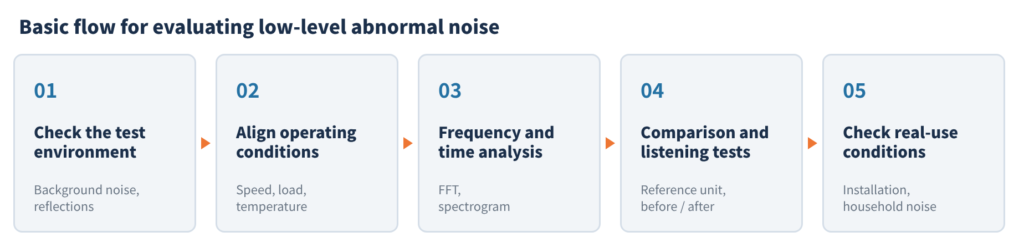
| 1. Check the test environment: | determine the levels of background noise and reflections. |
|---|---|
| 2. Align operating conditions | keep rotational speed, load, temperature and other conditions the same. |
| 3. Run frequency and time analysis | use FFT and spectrograms to find peaks, intermittent sounds and fluctuating sounds. |
| 4. Compare and run listening tests | compare data from reference units and from before and after improvements, and check audible differences as well. |
| 5. Check real-use conditions | confirm how the sound is perceived in actual installation conditions and in the presence of everyday household noise. |
7. Related acoustic measurement standards
| IEC 60704-1:2021 | specifies general requirements for measuring airborne acoustical noise emitted by household and similar electrical appliances. Air conditioning, heating and ventilation equipment that forms part of a building is outside its scope, but household fans, range hoods, dehumidifiers and air purifiers are included. Requirements for specific appliance types are given in the IEC 60704-2 series. |
|---|---|
| ISO 3745:2012 | specifies precision methods for determining sound power levels in anechoic and hemi-anechoic rooms. The change in how anechoic chambers are evaluated in this edition is explained in “Misconceptions About a Sound Absorption Coefficient of 0.99.” |
| ISO 532-1:2017 | specifies the method for calculating loudness (Zwicker method). |
| ECMA-418-1/ECMA-418-2 | ECMA-418-1 covers the identification of prominent discrete tones using the TNR and PR methods, and ECMA-418-2 specifies the calculation of loudness, tonality, roughness and fluctuation strength based on the Sottek Hearing Model. Because these standards mainly target product noise from information technology and telecommunications equipment, their application to home appliances should be considered according to the purpose of the evaluation. |
| DIN 45692:2009 | specifies the calculation of sharpness. |
For an overview of how to read the standards related to anechoic chambers, see “How to Read Standards Related to Anechoic Chambers.”
8. Frequently asked questions
Q. Do appliances develop more abnormal noise as they get quieter?
Not necessarily. In many cases, noise reduction simply makes small sounds that were always there easier to hear. On the other hand, design changes can also create new sounds, so the two cases should be distinguished during evaluation.
Q. Is the masking effect the same as the influence of background noise?
No. Masking is a phenomenon of human hearing. Background noise is sound other than the measurement target, and it affects measured values and analysis accuracy. The former is a question of how sound is heard; the latter is a question of how it is measured.
Q. Is an anechoic chamber always required to inspect low-level abnormal noise?
No. Anechoic chambers, semi-anechoic chambers and anechoic boxes are used according to the required accuracy, frequency range, test method and size of the test object. It is equally important to choose microphones and instruments whose self-noise is sufficiently lower than the target sound.
Summary: beyond noise reduction, evaluate sound quality
As home appliances become quieter, tonal and intermittent sounds that were previously hard to hear can become noticeable. Behind this is a mechanism of human hearing: as the broadband operating noise drops, masking weakens.
In future product development, it will be important to check not only how many decibels the noise is reduced, but also which frequency components remain and how they are perceived. Evaluating low-level sounds correctly requires instruments with low self-noise, consistent measurement conditions and a measurement environment with low background noise.
Moritani Shokai combines HBK measurement equipment with Sonora Technology measurement spaces to propose acoustic measurement solutions for research and development, product inspection and quality control. For help selecting a measurement system, building or upgrading an anechoic chamber or anechoic box, or meeting standards, please use our contact page. If you would like to see the equipment in person, our showroom and demos are also available.
Related information
- Simplified Performance Testing with Anechoic Box + Sound Level Meter
- Auto-door anechoic box for production-line acoustic inspection
- Acoustic Power Measurement
- Why HBK × SONORA?
- Showroom / Demo
References
- IEC 60704-1:2021, Household and similar electrical appliances – Test code for the determination of airborne acoustical noise – Part 1: General requirements. IEC Webstore
- ISO 3745:2012, Acoustics – Determination of sound power levels and sound energy levels of noise sources using sound pressure – Precision methods for anechoic rooms and hemi-anechoic rooms.
- ISO 532-1:2017, Acoustics – Methods for calculating loudness – Part 1: Zwicker method. ISO
- ECMA-418-1, 3rd edition (December 2024); ECMA-418-2, 4th edition (June 2025), Psychoacoustic metrics for ITT equipment. Ecma International
- DIN 45692:2009, Messtechnische Simulation der Hörempfindung Schärfe (Measurement technique for the simulation of the auditory sensation of sharpness).
- H. Fastl, E. Zwicker, Psychoacoustics: Facts and Models, 3rd ed., Springer, 2007.
Latest Posts in Technical Column
-
2026.10.21
Why Quieter Appliances Make Abnormal Noise More Noticeable | Masking and Sound Quality -
2026.10.07
Is It Okay to Measure Noise with a Smartphone? Limitations of Smartphone Noise Meters and Differences from B&K 2245 -

2026.09.30
Differences Between Free-Field, Pressure-Field, and Random-Incidence Microphones: How to Choose and Use Them for Your Measurement Space -
2026.08.03
Why Are Anechoic Chamber Walls Spiky? How Acoustic Wedges Work -
2026.07.28
White Noise vs Pink Noise vs Sweep Signals -
2026.07.13
Acoustic Adjustment with Soundproof Partitions ― Applications for Anechoic Chamber Tuning, Simplified Acoustic Measurements, and STI Environment Design ― -
2026.07.08
Why HBK × SONORA? ― The Benefits of Integrating Acoustic Instrumentation and Acoustic Test Environments ― -
2026.05.18
Misconceptions About a Sound Absorption Coefficient of 0.99 ― How ISO 3745:2012 Changed the Philosophy of Anechoic Room Evaluation ― -
2026.05.13
How to Use HATS ― Operating a Measurement System That Reproduces the Human Head and Ears Within the Framework of Standards and Acoustic Environments ― -
2026.04.13
Evaluation Methods in Building Acoustics: Streamlining Field Measurements and Material Assessment in Laboratory Environments

Contact Us
- Contact us by email
-
- Contact us by phone
-
Moritani Shokai
(Machinery Department No. 2, Tokyo Head Office)


Introduction of the Manufacturer
-
Hottinger Bruel & Kjaer
HHBK is a merger of two companies: Brüel & Kjær of Denmark and HBM of Germany.
Brüel & Kjær is one of the world’s leading manufacturers of acoustic and vibration measurement instruments, known as a total measurement chain supplier.Learn more about HBK
-
Sonora Technology Co., Ltd.
Sonora Technology is a leading Japanese manufacturer of industrial anechoic chambers and anechoic boxes.
From design and manufacturing to installation and acoustic performance assurance, Sonora provides fully integrated solutions to build complete acoustic measurement environments from the ground up.Learn more about Sonora
Contact / Request Brochure
For inquiries or consultations regarding the total solutions provided by HBK × Sonora, please feel free to contact us using the Contact button.
If you would like a brochure sent by mail, please use the Request Brochure button.