

Technical Column
Is It Okay to Measure Noise with a Smartphone? Limitations of Smartphone Noise Meters and Differences from B&K 2245
Oct 7, 2026
- HBK × SONORA Acoustic Measurement Solution Official Website
- Technical Column
- Is It Okay to Measure Noise with a Smartphone? Limitations of Smartphone Noise Meters and Differences from B&K 2245
Simplified Performance Testing Using Anechoic Box + Sound Level Meter
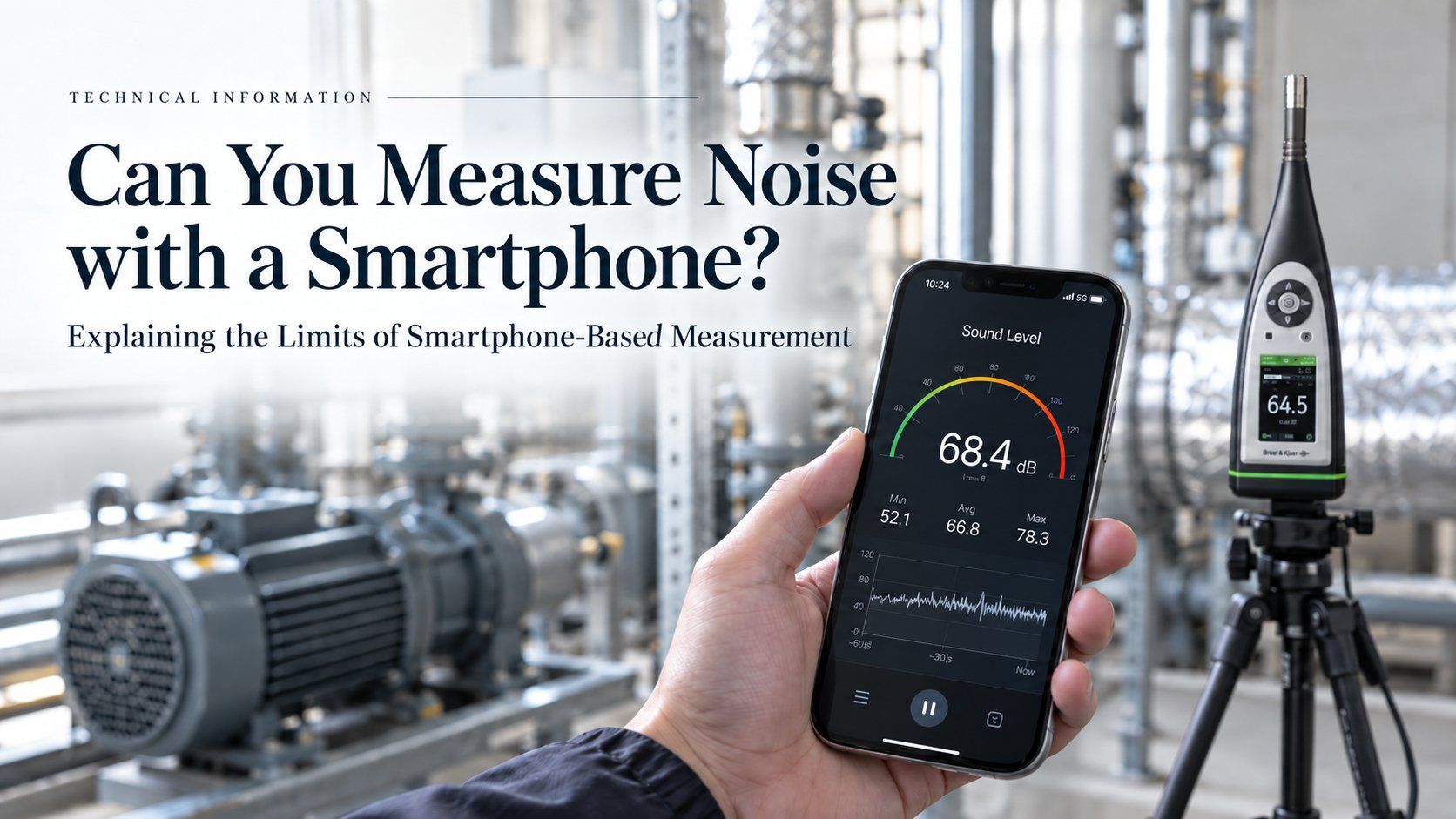
Conclusion: Sound level meter apps that use a smartphone’s built-in microphone are convenient for getting a rough estimate or conducting preliminary noise surveys. However, for formal evaluations, regulatory compliance, and product performance guarantees, a sound level meter compliant with standard specifications and an appropriate measurement environment are required. Furthermore, sound level meters like the B&K 2245 that connect with smartphones do not actually measure sound using the smartphone itself.
“I measured factory equipment noise on my smartphone for now and got 85 dB,” “I want to compare noise levels before and after installing soundproofing using a noise meter app” — with smartphones enabling us to quantify sound levels easily, such use cases have become common.
However, can these displayed values be treated the same way as those from a professional sound level meter?
In conclusion, smartphone noise meter apps are effective for screening to get a general idea of noise presence and magnitude. On the other hand, testing based on standards, regulatory compliance verification, client submissions, and product performance guarantees require comprehensive management including instrument performance, calibration, measurement conditions, and environment.
This article organizes the usable scope and limitations of smartphone measurement, explaining the differences compared to HBK’s Class 1 Sound Level Meter B&K 2245 and SONORA’s measurement environments such as anechoic chambers and boxes.
Smartphones Can Measure “Estimates” of Sound Pressure Levels
Smartphones are equipped with microphones for calls and video recording. Noise meter apps capture that microphone signal, calculate it, and convert it into a dB display. Simplifying the principle, it uses the same mechanism as dedicated sound level meters: “converting sound into electrical signals via a microphone, processing the signal, and displaying the level.”
Therefore, saying “smartphones cannot measure noise” is not entirely accurate. In verifications by US NIOSH, some tested iOS apps showed average differences within ±2 dBA compared to reference measurement systems, and follow-up tests using calibrated external microphones reported results approaching within ±1 dB.
However, these are results under specific devices, apps, and test conditions. Displaying “68.4 dB” on a screen and that value being a valid measurement usable for standards, regulations, or quality assurance are two separate matters.
Where Are the Limitations of Smartphone Measurement?
1. Built-in Microphones Are Not “Dedicated Measurement Microphones”
Smartphone microphones are designed for calls, recording, and voice recognition. In measurement microphones, characteristics such as frequency response, linearity, self-noise, and directivity are controlled as measurement performance, whereas in smartphones, characteristics vary depending on the model, implementation, and internal processing.
2. Upper Input Limits in Loud Sounds and Self-Noise in Quiet Sounds Pose Issues
With extremely loud sounds, the microphone or input circuit may saturate, causing clipping. Conversely, with low-noise products, the device’s own noise floor approaches the measurement target, making it difficult to separate the target sound from self-noise.
3. Results May Vary Across Different Devices Even Using the Same App
Android in particular varies across manufacturers and models in terms of microphones, audio processing ICs, and OS implementations. NIOSH also explains that uniform precision verification for Android devices is difficult due to hardware configuration diversity.
4. Understanding Settings Like A/C/Z Weighting, FAST/SLOW, LAeq Is Crucial
Noise evaluation metrics are not simply “dB.” It is necessary to use appropriate indicators for the purpose, such as frequency weighting, time weighting, equivalent continuous sound level, maximum value, or peak value. Comparing numbers without verifying the app’s display conditions may lead to comparing entirely different quantities.
5. Measurement Position, Orientation, and Handling Affect Values
Distance from the sound source, positional relationships with walls or floors, smartphone orientation, blocking the microphone hole with hands or cases, and reflection/shielding by the operator’s body all affect the results.
6. Significant Impact from Wind Outdoors
When wind hits the microphone, pressure fluctuations distinct from noise are added as wind noise. Professional measurements manage wind noise using windscreens and controlled measurement conditions.
7. The Biggest Difference Lies in “Calibration” and “Traceability”
In professional measurements, sensitivity checks are performed before and after measurements using a sound calibrator to verify the state of the measurement chain, including the meter and microphone. Adjusting the display using a smartphone app’s numerical offset feature is not the same as guaranteeing the performance of a measurement system.
“Measuring WITH a Smartphone” vs. “Measuring USING a Smartphone” Are Different
This is an important point in understanding HBK’s B&K 2245. While the B&K 2245 connects with smartphones, it is not a system that measures noise using the smartphone’s built-in microphone.
What actually measures sound is the B&K 2245 main unit microphone and measurement circuitry, which comply with IEC 61672-1 Class 1. The smartphone assists with operation, display, annotation, and data management through dedicated apps.
In short, the design concept is not “turning a smartphone into a noise meter,” but rather “making a standard-compliant sound level meter easier to use via a smart device.” HBK offers dedicated workflows by application, such as Noise Partner, Enviro Noise Partner, Work Noise Partner, and Product Noise Partner.
Key Points
Smartphone noise meter apps: The smartphone’s built-in microphone is the core measurement tool.
B&K 2245 + Smartphone: The B&K 2245 is the measurement instrument. The smartphone assists with operation, display, and recording.
What Makes the B&K 2245 Different?
The B&K 2245 is designed as an IEC 61672-1 Class 1 sound level meter, supporting measurement workflows tailored to general noise, environmental noise, workplace noise, and product noise.
In addition to broadband measurements, depending on configuration, 1/1 octave or 1/3 octave frequency analysis and logging features are available. Wireless connectivity with smartphones and PCs streamlines measurement operation, recording, and reporting tasks.
However, being IEC 61672-1 Class 1 compliant does not automatically mean it can be used for “commercial transactions or certification” in Japan. When conducting official measurements or regulatory testing in Japan, it is necessary to verify the validity of verification marks/compliance seals under the Measurement Act and specific measurement requirements.
Smartphone Apps Alone Cannot Replace Statutory Measurements in Japan
In Japan, sound level meters are classified as specified measuring instruments under the Measurement Act. When using specified measuring instruments for transactions or certifications, they must bear a valid verification stamp or compliance mark. According to Ministry of Economy, Trade and Industry documents, the verification validity period for sound level meters is 5 years.
Furthermore, regulations regarding noise emitted from specified factories dictate using sound level meters passed under Article 71 of the Measurement Act, set to A-weighting and FAST time response. The same applies to specified construction work.
Therefore, a combination of a standard smartphone and a noise meter app cannot substitute for official measurements.
How to Choose Between Smartphone, B&K 2245, and Test Rooms?
| Comparison Item | Smartphone Noise App | B&K 2245 | B&K 2245 + SONORA Environment |
|---|---|---|---|
| Main Purpose | Preliminary survey / estimate | On-site precision measurement | Product evaluation / repeatable testing |
| Measurement Mic | Smartphone built-in | Dedicated measurement mic / unit | Dedicated measurement mic / unit |
| Standard Performance | Device / App dependent | IEC 61672-1 Class 1 | Class 1 measurement + controlled sound field |
| Calibration | Limited | Sound calibrator check available | Calibration + environment management |
| Reflection & Ambient Noise Control | Basically impossible | Affected by field conditions | Reduced via anechoic chamber / box |
| Suitable Applications | “Where is it noisy?” screening | Environmental / workplace / product measurement | Low-noise products, sound power, performance comparison, etc. |
| Status as Official Value | Generally not allowed | Check purpose, verification status, procedure | Check purpose, standard, verification status, test room conditions |
When Smartphone Measurement Is Suitable
Initial Screening to Locate Noise Sources
Walking around a factory to roughly identify which equipment shows higher noise levels, narrowing down locations for primary measurement.
Confirming Clearly Significant Changes
Measuring at the same location and orientation with the same device and app to check for large differences before and after countermeasures. Small differences of a few dB are hard to distinguish from errors and should not be treated as official improvement amounts.
Entry Point to Decide If Professional Measurement Is Needed
Information such as “It was around 80–90 dBA on a smartphone” or “It changes drastically when specific equipment turns ON/OFF” serves as criteria for deciding what measurement to perform next.
In Noise Control, Look at “Which Hz” as Well as “How Many dB”
In noise mitigation, causes cannot be identified solely from overall sound levels. Even at the same 80 dBA, effective countermeasures differ between fans/blowers dominated by low frequencies and air leaks/gear noises with strong high-frequency components.
With the B&K 2245, octave band analysis can be used depending on configuration, and more detailed analysis combines HBK microphones and data acquisition/analysis systems. When measuring low-noise products, suppressing background noise and reflections using SONORA anechoic chambers or boxes is key.
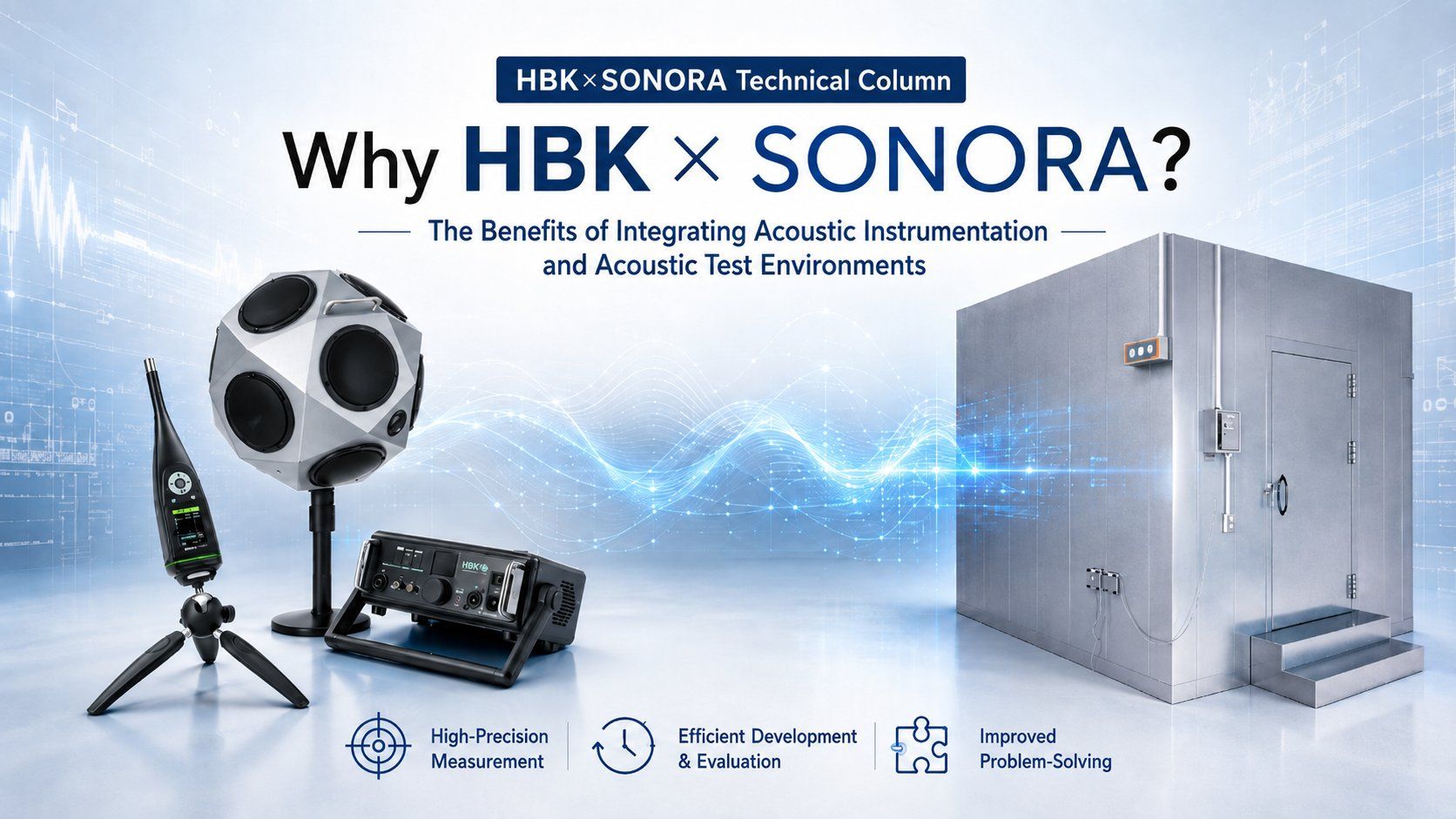
Why HBK × SONORA Considers “Instruments and Space” Together
Even when using a high-precision sound level meter, if surrounding noise or reflections contaminate the measured value, the sound of the test object itself cannot be correctly evaluated. Conversely, even with a high-performance anechoic chamber, if microphone selection, calibration, measurement placement, and analysis conditions are inappropriate, the facility’s capabilities cannot be fully utilized.
HBK provides sound level meters, measurement microphones, and data acquisition/analysis technologies, while SONORA constructs measurement spaces like anechoic rooms, semi-anechoic rooms, anechoic boxes, and soundproof rooms. Moritani & Co. proposes acoustic measurement solutions combining both based on measurement objectives.
It is essential to select measurement methods step-by-step according to goals: from “discovering” noise with a smartphone, to “measuring correctly” with the B&K 2245, and “evaluating with high repeatability” in a SONORA environment.
Summary | Smartphones Are the Entrance; Accurate Evaluation Requires “Meter + Conditions + Environment”
Smartphone noise meter apps are convenient for preliminary surveys to roughly understand the presence and level of noise.
However, due to limitations in built-in mic characteristics, measurement range, device differences, calibration, test conditions, and standard compliance, they cannot be directly used for formal evaluation values.
With smartphone-linked sound level meters like the B&K 2245, actual measurement is handled by the dedicated Class 1 measurement system, while the smartphone assists with operation, display, and recording.
Furthermore, in product noise and low-noise measurements, managing ambient noise and reflections using SONORA anechoic chambers/boxes allows the measurement equipment to perform at its full potential.
Frequently Asked Questions (FAQ)
Q. Are smartphone noise meter apps accurate?
Under certain conditions, some apps yield values close to professional sound level meters, but errors vary depending on the device, app, frequency, and sound pressure range. The rule of thumb is to use them as rough estimates for preliminary surveys and use appropriate sound level meters for formal evaluations.
Q. Can iPhones be used for official noise measurements?
While NIOSH studies reported favorable results for some iOS apps, using an iPhone itself does not guarantee standard compliance or fulfillment of requirements under Japan’s Measurement Act.
Q. The B&K 2245 also uses a smartphone—how is it different?
In the B&K 2245, sound is measured by the Class 1 measurement system inside the 2245 main unit. The smartphone operates, displays, and manages data via a dedicated app, making its architecture fundamentally different from apps that measure sound using a smartphone’s built-in mic.
Q. Can the B&K 2245 always be used for statutory measurements?
Compliance with IEC 61672-1 Class 1 is separate from Japanese Measurement Act verifications and statutory measurement requirements. For transactions, certifications, or regulatory measurements in Japan, it is necessary to check the validity of verification marks on the specific unit and follow prescribed measurement methods.
Q. Can soundproofing effects be verified with a smartphone?
They can be used for preliminary measurements to confirm large changes. However, when guaranteeing that sound insulation performance improved by a specific number of dB, measurement conditions must be controlled and measured with an appropriate sound level meter.
Q. When are anechoic chambers or boxes required?
They are needed when evaluating quiet products, comparing subtle differences before and after soundproofing, or evaluating sound power and frequency characteristics with high repeatability. Ambient noise and reflections must be significantly lower than the measurement target.
Related Articles
- The New Generation of Mobile Acoustic Measurement — Field Accuracy for Building and Environmental Sound Testing —
- Why HBK × SONORA? ― The Benefits of Integrating Acoustic Instrumentation and Acoustic Test Environments ―
- Simplified Performance Measurement Using an Anechoic Box and a Sound Level Meter
- Common Acoustic Measurement Issues and Noise Countermeasures in Anechoic Chambers and Anechoic Boxes
Latest Posts in Technical Column
-
2026.10.07
Is It Okay to Measure Noise with a Smartphone? Limitations of Smartphone Noise Meters and Differences from B&K 2245 -

2026.09.30
Differences Between Free-Field, Pressure-Field, and Random-Incidence Microphones: How to Choose and Use Them for Your Measurement Space -
2026.08.03
Why Are Anechoic Chamber Walls Spiky? How Acoustic Wedges Work -
2026.07.28
White Noise vs Pink Noise vs Sweep Signals -
2026.07.13
Acoustic Adjustment with Soundproof Partitions ― Applications for Anechoic Chamber Tuning, Simplified Acoustic Measurements, and STI Environment Design ― -
2026.07.08
Why HBK × SONORA? ― The Benefits of Integrating Acoustic Instrumentation and Acoustic Test Environments ― -

2026.05.18
Misconceptions About a Sound Absorption Coefficient of 0.99 ― How ISO 3745:2012 Changed the Philosophy of Anechoic Room Evaluation ― -
2026.05.13
How to Use HATS ― Operating a Measurement System That Reproduces the Human Head and Ears Within the Framework of Standards and Acoustic Environments ― -
2026.04.13
Evaluation Methods in Building Acoustics: Streamlining Field Measurements and Material Assessment in Laboratory Environments -

2026.03.23
We participated in the corporate exhibition at the Acoustical Society of Japan (ASJ) Meeting on March 19, 2026

Contact Us
- Contact us by email
-
- Contact us by phone
-
Moritani Shokai
(Machinery Department No. 2, Tokyo Head Office)


Introduction of the Manufacturer
-

Hottinger Bruel & Kjaer
HHBK is a merger of two companies: Brüel & Kjær of Denmark and HBM of Germany.
Brüel & Kjær is one of the world’s leading manufacturers of acoustic and vibration measurement instruments, known as a total measurement chain supplier.Learn more about HBK
-
Sonora Technology Co., Ltd.
Sonora Technology is a leading Japanese manufacturer of industrial anechoic chambers and anechoic boxes.
From design and manufacturing to installation and acoustic performance assurance, Sonora provides fully integrated solutions to build complete acoustic measurement environments from the ground up.Learn more about Sonora
Contact / Request Brochure
For inquiries or consultations regarding the total solutions provided by HBK × Sonora, please feel free to contact us using the Contact button.
If you would like a brochure sent by mail, please use the Request Brochure button.