

Technical Column
Designing Office Speech by the Numbers | STI, ISO 3382-3 and DIRAC
Nov 19, 2026
- HBK × SONORA Acoustic Measurement Solution Official Website
- Technical Column
- Designing Office Speech by the Numbers | STI, ISO 3382-3 and DIRAC
Written by Moritani Shokai Co., Ltd. / Technical supervision: Sonora Technology Co., Ltd.
In meeting rooms, voices should come across clearly; in work areas, the conversation at the next desk should not be a distraction. Achieving both starts with measuring how speech actually travels through a space. This article focuses on the Speech Transmission Index (STI), which describes how well speech is conveyed, and on ISO 3382-3, the international standard for open-plan offices. It explains how to build a measurement system around HBK’s DIRAC room acoustics software and how to turn the results into improvements.
Video: hearing STI (2 min 22 s)
This video presents the STI qualification bands, a comparison of four meeting-room conditions, and an open-plan office before and after treatment, in 2 minutes 22 seconds. Headphones are recommended.
1. Two opposite requirements for office acoustics
Office spaces call for opposite acoustic performance depending on how they are used. With the same yardstick — how well speech is conveyed — some spaces need a high value and others need a low one.
| Space | Required performance | What to measure | Main metrics |
|---|---|---|---|
| Meeting rooms, web-conference rooms, training rooms | Speech is conveyed | Whether speech is intelligible at every seat in the room | STI, reverberation time |
| Open-plan office (work area) | Speech does not carry too far | How far conversations at nearby desks and workstation clusters remain distracting | D2,S, Lp,A,S,4m, rD, rC |
| Reception rooms, executive offices, meeting booths | Speech does not leak out | Whether conversations can be understood outside the walls and doors | STI outside the room, sound insulation |
If renovations are based only on impressions such as “it’s noisy” or “it’s hard to hear”, there is no way to verify the effect afterwards. Measuring the current situation with standardized metrics, and measuring again the same way after the work, makes it possible to explain the return on the investment.
2. What is STI (Speech Transmission Index)?
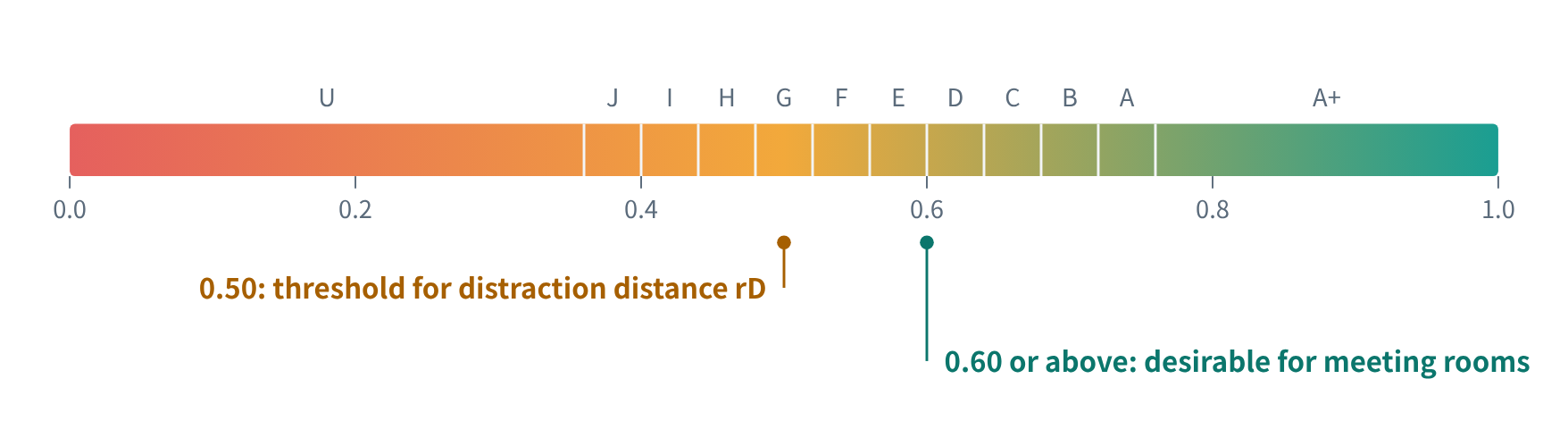
STI expresses, on a scale from 0 to 1, how much of the original character of a talker’s voice is preserved by the time it reaches the listener through the room and any sound system. The closer the value is to 1, the clearer the speech; 0.6 or higher is generally considered desirable. What STI evaluates is not how well someone speaks, but how much the transmission path degrades the voice.
The three main factors that lower STI are:
- Reverberation: reflections overlap the following syllables and blur the outline of words
- Background noise: noise from air conditioning and office equipment masks the rise and fall of the voice
- Sound system characteristics: equalization for effect or changes in the transmission chain can lower the value
Conversely, reducing reverberation with sound absorption and lowering equipment noise raises the STI of a meeting room. In an open-plan office, the goal is the opposite — lowering STI at distant desks — and techniques such as sound masking, which deliberately adds background sound, are also used.
Listening comparison: the same sentence at three STI values
The speech level is 58 dB(A) in every case; only the reverberation time and background noise change. Differences in loudness are part of the conditions, so please keep the playback volume fixed.
Original (reference)
No reverberation or noise
STI 0.71 Meeting room with acoustic treatment
Reverberation time approx. 0.5 s / background noise 40 dB(A)
STI 0.52 Reverberant meeting room
Reverberation time approx. 1.2 s / background noise 46 dB(A)
STI 0.31 Large space with a high ceiling
Reverberation time approx. 3.0 s / background noise 54 dB(A)
Standard: IEC 60268-16:2020 (Edition 5)
The STI calculation model, test signals and measurement and prediction methods are specified in IEC 60268-16. In the current fifth edition (September 2020), the spectrum of the male test signal was substantially reduced in the 125 Hz and 250 Hz bands, and the female spectrum and weighting factors were removed. Corrigendum 1 (COR1) was also published in July 2025. There are three main families of measurement methods:
- Direct method (full STI): a modulated test signal is played and the remaining modulation is measured at the receiver position
- STIPA: a simplified version of the direct method, widely used for inspecting public address and voice alarm systems. It can also be measured with DIRAC
- Indirect method (impulse response method): STI is calculated from the impulse response, taking speech level and background noise into account. This is DIRAC’s basic method, and room acoustic parameters such as reverberation time are obtained at the same time
DIRAC is based on the indirect method, but it also supports direct-method measurement with STIPA.
3. Metrics and standards by type of space
Meeting rooms and web-conference rooms: STI and reverberation time
In a meeting room, STI is measured at several seats from the talker position to confirm that even the worst seat meets the target. Measuring reverberation time according to ISO 3382-2 at the same time makes it possible to tell whether a low STI is caused by reverberation or by noise. In web conferences, room reverberation is picked up by the microphone and becomes even harder to understand at the far end, so acoustic treatment pays off even more than in face-to-face meetings.
Open-plan offices: ISO 3382-3:2022
Open-plan offices have problems that reverberation time alone cannot capture. ISO 3382-3 therefore expresses, as single-number values, how speech from one talker decays with distance and how far its content remains intelligible. Measurements are made in the furnished but unoccupied office, with air conditioning and other building services running as during normal working hours.
| Metric | Meaning | Unit | Typical good value | Typical poor value |
|---|---|---|---|---|
| D2,S | Spatial decay rate of A-weighted speech level per doubling of distance | dB | 7 or more | less than 5 |
| Lp,A,S,4m | A-weighted speech level at 4 m from the talker | dB | 48 or less | more than 50 |
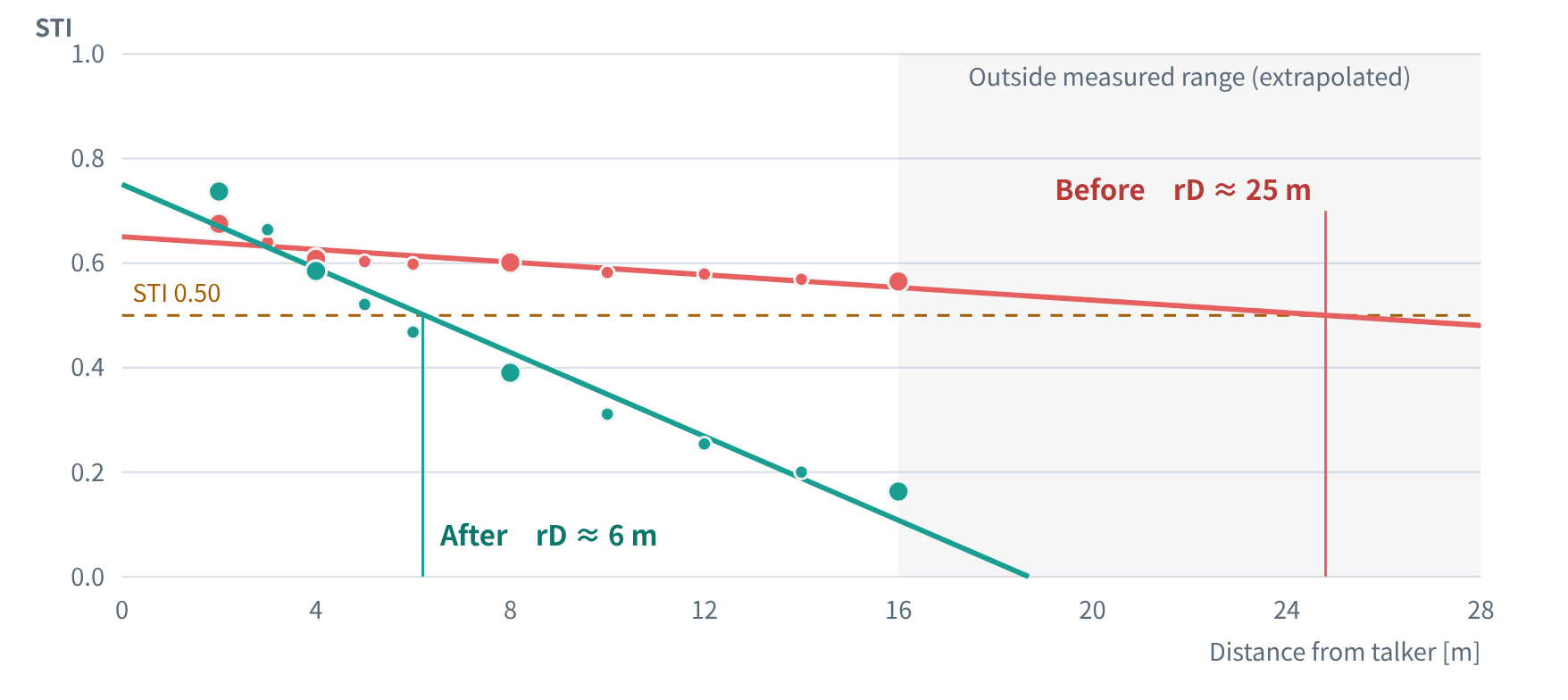
| rD (distraction distance) | Distance at which STI falls below 0.50 | m | 5 or less | more than 10 |
| rC (comfort distance) | Distance at which the speech level falls below 45 dB | m | Shorter is better | ― |
| Lp,A,B | Background noise level (including air conditioning and masking) | dB | ― | ― |
The “good” and “poor” values are typical values given in the annex of the 2012 edition and in Nordic research; they are not pass/fail criteria of the standard. Field measurements have reported rC values mostly between about 3 m (strong decay) and 30 m (weak decay).
Listening comparison: seats 2, 4, 8 and 16 m from the talker
Before: D2,S 4 dB, Lp,A,S,4m 52 dB, background noise 35 dB(A). After (sound-absorbing ceiling + partitions + sound masking): D2,S 8 dB, Lp,A,S,4m 47 dB, background noise 42 dB(A).
Before
2 m STI 0.68
Speech 56 dB(A)
4 m STI 0.61
Speech 52 dB(A)
8 m STI 0.60
Speech 48 dB(A)
16 m STI 0.56
Speech 44 dB(A)
After
2 m STI 0.74
Speech 55 dB(A)
4 m STI 0.58
Speech 47 dB(A)
8 m STI 0.39
Speech 39 dB(A)
16 m STI 0.16
Speech 31 dB(A)
The second edition of 2022 added a new metric, the comfort distance rC, and removed the privacy distance rP (the distance at which STI falls to 0.20) of the previous edition. It also makes clear that an omnidirectional sound source is to be used in all measurement steps. When comparing with reports based on the previous edition, always state which edition was used.
Guidance for the design stage: ISO 22955:2021
ISO 22955 is a technical guideline that helps clients, designers and contractors share a common understanding of acoustic quality in open offices. A practical feature is that it classifies spaces into six types according to the work carried out:
- 1. Undefined use (shell-and-core floor)
- 2. Mainly external communication, such as phone and web calls
- 3. Mainly collaborative work between nearby desks
- 4. Little collaborative work (mainly individual work)
- 5. Including reception of visitors
- 6. A mix of the above
Note that this standard has been under revision since October 2024, so future developments should be followed.
4. Measurement system built around DIRAC
DIRAC is based on measuring and analyzing impulse responses, and a single program calculates everything from reverberation time to STI and the ISO 3382-3 parameters. Peripheral equipment is a combination of a “sound-emitting side” and a “sound-receiving side”, chosen according to the space and the metrics to be measured.
| Role | HBK product | Key points |
|---|---|---|
| Software | DIRAC Room Acoustics Software Type 7841 | Supports ISO 3382, ISO 18233 and IEC 60268-16. Includes multichannel measurement, real-time frequency analysis, auralization, and comparison and statistical processing of results |
| Speech source (talk box) | Echo Speech Source Type 4720 | Calibrated source with directivity close to the human mouth. Reference level 60 dB(A) at 1 m, 125 Hz to 8 kHz, five built-in signals. Approx. 1 kg, battery-powered, tripod-mountable. Each unit is calibrated in an anechoic chamber |
| Omnidirectional loudspeaker | OmniPower Omnidirectional Sound Source Type 4292-L | The omnidirectional source required by ISO 3382-3:2022. Also used for reverberation time measurements |
| Amplifier and audio interface | HBK 2755 Smart Power Amplifier | Connects to DIRAC via USB and combines amplifier, microphone inputs and sound card in one unit. Also supports asynchronous measurement with its built-in signal generator |
| Microphone / sound level meter | HBK 2255 Sound Level Meter | Used as a wireless microphone for DIRAC. Several units allow multichannel measurement. Can also measure background noise on its own |
| General-purpose audio interface | Windows-compatible multichannel sound device | Existing equipment can also be used. Check the input/output calibration procedure in advance |
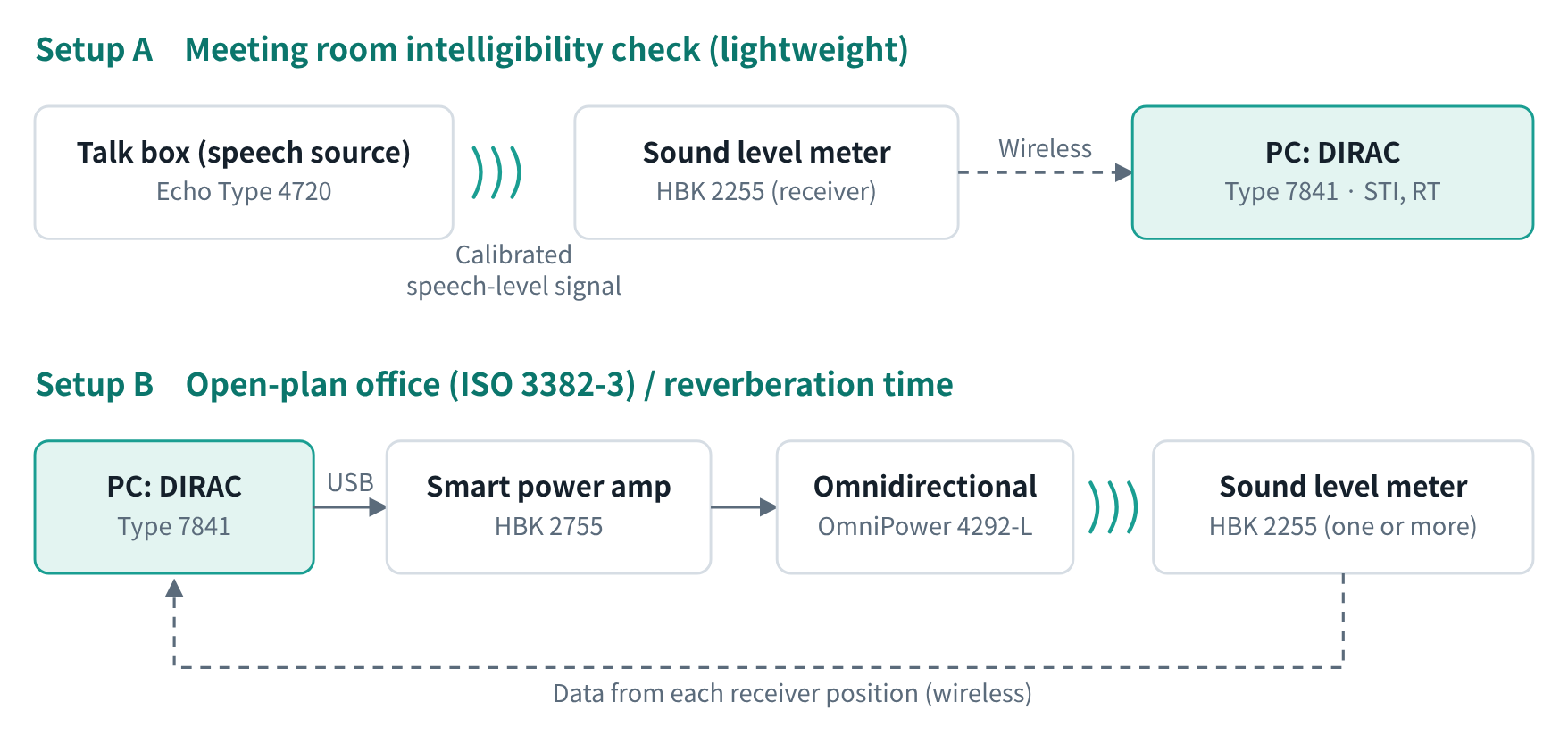
Setup A: speech intelligibility check in meeting rooms (lightweight)
DIRAC + Echo Speech Source Type 4720 + HBK 2255. No cable is needed between the source and the microphone: place the source at the talker position and move between listener seats. The Echo signal is encoded so that DIRAC can identify its output level, so there is no need to adjust the speech level with an external equalizer or similar. When background noise is high, the signal can be raised to 72 dB(A) for the measurement and correctly compensated in the calculation.
Setup B: open-plan offices (ISO 3382-3) / reverberation time
DIRAC + OmniPower Type 4292-L + HBK 2755 + HBK 2255 (one or more units). Because ISO 3382-3:2022 assumes an omnidirectional source, this setup is the choice for measurements where standards compliance matters, such as design verification and acceptance testing. Another advantage is that the same equipment can be used for reverberation time and sound insulation measurements between rooms.
Distance-based display in DIRAC and obtaining source–receiver distances
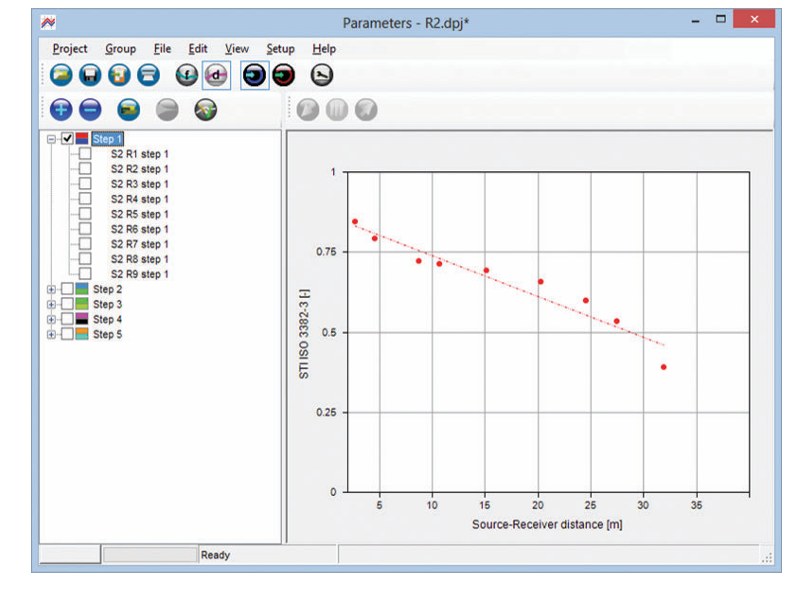
DIRAC can display the STI and speech level at each receiver position on a graph with the source–receiver distance on the horizontal axis (Figure 4). From the regression lines it calculates the distraction distance rD, the comfort distance rC, D2,S and Lp,A,S,4m, so that all ISO 3382-3 parameters can be reviewed and exported together.
How the source–receiver distances are provided depends on how the equipment is connected:
- Wireless setup (for example, when the HBK 2255 is used as a wireless microphone): enter the source–receiver distance for each receiver position manually.
- Wired setup (HBK 2755 connected via USB, synchronous measurement with signal playback and recording on the same device): after a distance calibration (Calibrate S-R distance) with a loopback cable, source–receiver distances are measured automatically.
Measurements according to ISO 3382-3 require three calibrations: system calibration, input level calibration and source–receiver distance calibration.
5. How to carry out the measurements
Open-plan offices (ISO 3382-3)
- 1. Define the measurement path: on the floor plan, set a path that follows the workstations, starting from the talker position. Place several receiver positions between 2 and 16 m from the source.
- 2. Prepare the measurement conditions: with furniture in place and the office unoccupied, run air conditioning and sound masking as during normal working hours.
- 3. Measure the background noise: at each receiver position, record the level with the source switched off (Lp,A,B) using the HBK 2255.
- 4. Measure the impulse responses: place the omnidirectional source at the talker position and measure at each receiver position. DIRAC immediately calculates the speech level and STI.
- 5. Obtain the single-number values by regression: derive D2,S, Lp,A,S,4m and rC from the relationship between distance and speech level, and rD from the point where the regression line of STI versus distance crosses 0.50 (Figure 2).
- 6. Record the conditions in the report: state the edition of the standard, the source, the path plan and the background noise conditions so that results can be compared with a re-measurement after treatment.
Meeting rooms and web-conference rooms
- Place the Echo speech source at the talker position (for example, the chair’s seat or in front of the display).
- Measure STI at several seats in the room, at roughly seated ear height. In web-conference rooms, also include the conference microphone position as a receiver position.
- Measuring with the air conditioning on and off makes it possible to tell whether a drop in STI is caused by reverberation or by noise.
- Report not only the average but also the value at the worst seat, and evaluate it alongside the frequency characteristics of the reverberation time.
6. Turning measurement results into improvements
The value of the numbers lies in showing where to make changes. Typical patterns of results and the direction of countermeasures are summarized below.
| Result | Likely cause | Countermeasure | Metrics to check when re-measuring |
|---|---|---|---|
| Low STI and long reverberation time in a meeting room | Insufficient sound absorption in the room | Add sound-absorbing material to the ceiling and walls | STI, reverberation time |
| Low STI but appropriate reverberation time in a meeting room | Noise from air conditioning or equipment | Silence diffusers and ducts, review equipment placement | Background noise level, STI |
| Small D2,S (speech carries far) | Reflections from ceiling and walls, no screening | Highly absorbent ceiling, sound-absorbing partitions, workstation layout | D2,S, rC |
| Long rD (conversations remain intelligible at a distance) | Insufficient decay, background noise too low | Decay measures + sound masking | rD, Lp,A,B |
| Speech leaks from reception rooms or executive offices | Insufficient sound insulation of partitions and doors | Improve insulation of partitions and doors, install soundproof rooms or booths | STI outside the room, sound insulation |
DIRAC’s auralization function also helps build consensus on countermeasures. By convolving speech with the measured impulse response, you can play back on the spot what speech sounds like at a given seat. Even general affairs and facility managers who are not familiar with the numbers can hear for themselves why treatment is needed and what effect it has.
Based on such measurement results, Sonora Technology provides everything from sound absorption and insulation measures to the design and construction of soundproof rooms and booths. Re-measuring under the same conditions after treatment and reporting the improvement in numbers makes it easier to explain the outcome of the investment within the organization.
7. Summary
- In offices, the goals for spaces that should convey speech and spaces where speech should not carry too far are opposite. Both can be evaluated with STI as the common axis
- Evaluate meeting rooms with STI and reverberation time, and open-plan offices with D2,S, Lp,A,S,4m, rD and rC of ISO 3382-3:2022
- Build the system around DIRAC, combining speech source, omnidirectional source, amplifier and sound level meter according to the purpose
- Measuring before and after treatment under the same conditions is the shortest way to explain an investment in acoustics in numbers
For advice on choosing measurement equipment or on how to proceed from measurement to renovation, please use our contact page. If you would like to see the equipment in person, our showroom and demos are also available.
Related information
- Acoustic Adjustment with Soundproof Partitions
- Evaluation Methods in Building Acoustics
- Is It Okay to Measure Noise with a Smartphone?
- Why HBK × SONORA?
- Showroom / Demo
References
- IEC 60268-16:2020, Sound system equipment – Part 16: Objective rating of speech intelligibility by speech transmission index. IEC Webstore
- ISO 3382-3:2022, Acoustics – Measurement of room acoustic parameters – Part 3: Open plan offices. Preview
- ISO 22955:2021, Acoustics – Acoustic quality of open office spaces. Standard information
- HBK: DIRAC Room Acoustics Software Type 7841
- HBK: DIRAC product data, BP 1974
- HBK: Echo Speech Source Type 4720
- HBK: HBK 2755 Smart Power Amplifier
- V. Hongisto, J. Keränen, Comfort Distance — A Single-Number Quantity Describing Spatial Attenuation in Open-Plan Offices, Applied Sciences, 2021
The speech samples and video on this page were created by adding calculated room responses and background noise to synthesized English speech. The STI values are simplified calculations based on the indirect method of IEC 60268-16, not measurements of real rooms. The values in Figure 2 come from the same calculated example.
Latest Posts in Technical Column
-
2026.11.19
Designing Office Speech by the Numbers | STI, ISO 3382-3 and DIRAC -
2026.10.21
Why Quieter Appliances Make Abnormal Noise More Noticeable | Masking and Sound Quality -
2026.10.07
Is It Okay to Measure Noise with a Smartphone? Limitations of Smartphone Noise Meters and Differences from B&K 2245 -

2026.09.30
Differences Between Free-Field, Pressure-Field, and Random-Incidence Microphones: How to Choose and Use Them for Your Measurement Space -
2026.08.03
Why Are Anechoic Chamber Walls Spiky? How Acoustic Wedges Work -
2026.07.28
White Noise vs Pink Noise vs Sweep Signals -
2026.07.13
Acoustic Adjustment with Soundproof Partitions ― Applications for Anechoic Chamber Tuning, Simplified Acoustic Measurements, and STI Environment Design ― -
2026.07.08
Why HBK × SONORA? ― The Benefits of Integrating Acoustic Instrumentation and Acoustic Test Environments ― -

2026.05.18
Misconceptions About a Sound Absorption Coefficient of 0.99 ― How ISO 3745:2012 Changed the Philosophy of Anechoic Room Evaluation ― -
2026.05.13
How to Use HATS ― Operating a Measurement System That Reproduces the Human Head and Ears Within the Framework of Standards and Acoustic Environments ―

Contact Us
- Contact us by email
-
- Contact us by phone
-
Moritani Shokai
(Machinery Department No. 2, Tokyo Head Office)


Introduction of the Manufacturer
-

Hottinger Bruel & Kjaer
HHBK is a merger of two companies: Brüel & Kjær of Denmark and HBM of Germany.
Brüel & Kjær is one of the world’s leading manufacturers of acoustic and vibration measurement instruments, known as a total measurement chain supplier.Learn more about HBK
-
Sonora Technology Co., Ltd.
Sonora Technology is a leading Japanese manufacturer of industrial anechoic chambers and anechoic boxes.
From design and manufacturing to installation and acoustic performance assurance, Sonora provides fully integrated solutions to build complete acoustic measurement environments from the ground up.Learn more about Sonora

Contact / Request Brochure
For inquiries or consultations regarding the total solutions provided by HBK × Sonora, please feel free to contact us using the Contact button.
If you would like a brochure sent by mail, please use the Request Brochure button.